
Review · ITALY
PompeiI Exclusive Tour with your Archaeologist in a Small Group
Pompeii is much easier to understand with an archaeologist beside you. In two hours, you move from the sea-facing Porta Marina to the Forum, food shops, bathhouses, private homes, and the theater, with someone explaining not only what you are seeing but how archaeologists know it.
I like the small-group format, capped at 15 people, and the chance to hear guides such as Ricardo, Raffaele, Antonio, and Ornella explain Roman daily life in clear English. I also like the focused route: you see important parts of a huge site without spending the first hour wondering which street to follow.
The main catch is simple: the €19 adult entry ticket is not included in the tour price. A few practical details also deserve attention. The route may not include the amphitheater or brothels, and Casa del Fauno and the House of the Vettii can close seasonally.
Key points to know before booking
- Two hours with an archaeologist: You get context for buildings, streets, artifacts, and plaster casts rather than simply walking past ancient walls.
- A focused route through Pompeii: The tour covers Porta Marina, the Forum, temples, baths, shops, homes, Via dell’Abbondanza, and the theater.
- Small group, up to 15 people: This should make it easier to hear the guide and ask questions, though one account reported a group of about 20.
- Entry costs extra: The tour price is $30.25 per person, while Pompeii admission is listed separately at €19 for adults and free for visitors under 18.
- Excellent guide feedback: Ricardo, Raffaele, Antonio, Ornella, PierLuigi, and others are praised for clear explanations, warmth, humor, and strong archaeological knowledge.
- Comfortable shoes matter: Pompeii means uneven ancient paving and plenty of walking. Bring footwear suited to rough ground.
Why an archaeologist changes the Pompeii visit
Pompeii is not a single monument. It is a large ancient city with streets, houses, temples, shops, public buildings, and theaters spread across a wide archaeological park. Without context, you can see plenty and still miss what made each place important.
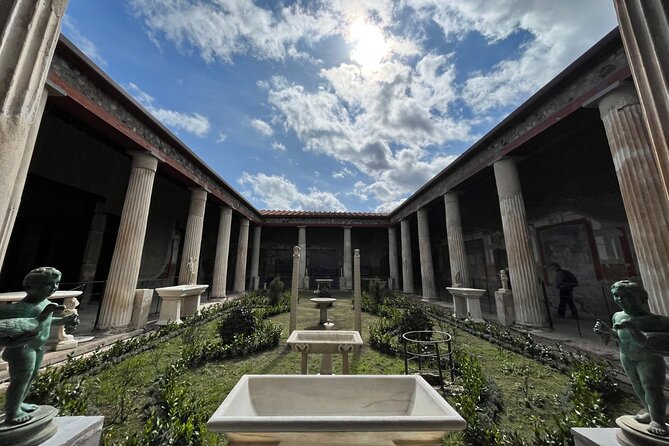
This tour gives you a guide who can connect the pieces. At a bakery or thermopolium, you learn about everyday food and trade. At the Forum, you see where public life took place. In a private house, mosaics, wall decoration, and household shrines help explain status and belief.
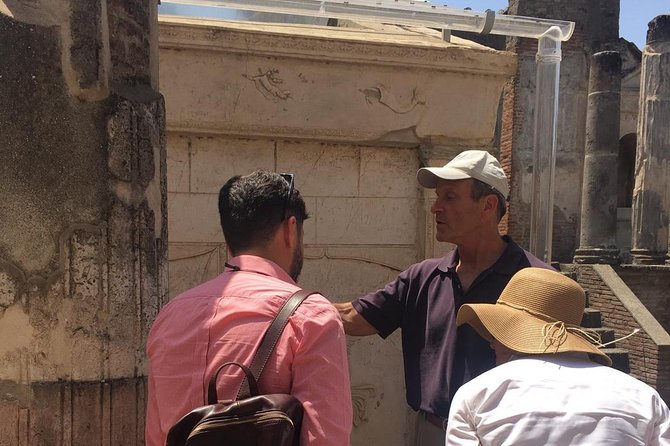
The strongest part of the experience is the guide’s interpretation. Ricardo is praised for explaining how archaeologists reach their conclusions, not just reciting labels. Raffaele is described as both friendly and precise, while Antonio is noted for using questions and humor to keep the group involved.
That matters at Pompeii. You are not only looking at old stones. You are trying to understand how a Roman town worked, how people moved through it, and what the eruption left behind.
More Premium Small-Group Tours in Italy
- VIP Colosseum Underground and Ancient Rome Small Group Tour
★ 4.5 · 332 reviews - Premium Small-Group Uffizi Tour
★ 4.5 · 301 reviews - Colosseum Underground and Roman Forum: Small Group Exclusive Tour
★ 5.0 · 214 reviews
Meeting at Porta Marina Superiore
The meeting point is outside the archaeological park at Via Villa dei Misteri 1. Look for the guide holding a sign marked Pompeii Vip. The specified entrance is Porta Marina Superiore, the western gateway to the ancient city.
The name comes from the road that once led toward the sea. It is a useful starting point because the route takes you straight into the public heart of Pompeii rather than beginning with a random side street.
The guide will help with the entry process, but the ticket arrangement requires care. The $30.25 booking price is for the guided experience, not admission to the archaeological site. The stated adult admission is €19, and children under 18 enter free according to the supplied information.
The operator sends a link to purchase skip-the-line admission online, described as a safe and quick option. You can also buy the entry ticket on site with assistance. I would sort this out before arriving, since confusing the tour confirmation with the park ticket could create an unnecessary delay.
From Venus to the Forum
The first major sight is the Temple of Venus, dedicated to Pompeii’s patron goddess. Its position near the western entrance makes it an early lesson in how religion shaped the city. The guide’s role here is to give the ruin a place in Pompeii’s civic and religious life.
Next comes the Basilica. This was not a church in the modern sense. It was one of the Forum’s grandest buildings, used for business and the administration of justice.
That distinction is useful because Roman public buildings often have familiar names with unfamiliar purposes. A guide can explain what happened inside instead of leaving you to guess from the columns and foundations.
The Sanctuary of Apollo follows. It is among Pompeii’s oldest places of worship and occupied an important position along the road from Porta Marina to the city center. Even a short explanation here helps you see the route as an organized urban entrance, not just a series of ruins.
Then you reach the Forum, Pompeii’s main square. This is the civic center of the tour and one of the places where the archaeologist’s commentary has the most value. The Forum was tied to public business, religion, politics, and daily movement.
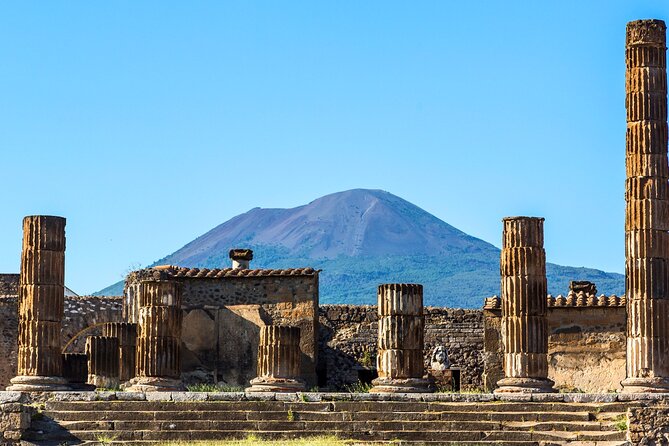
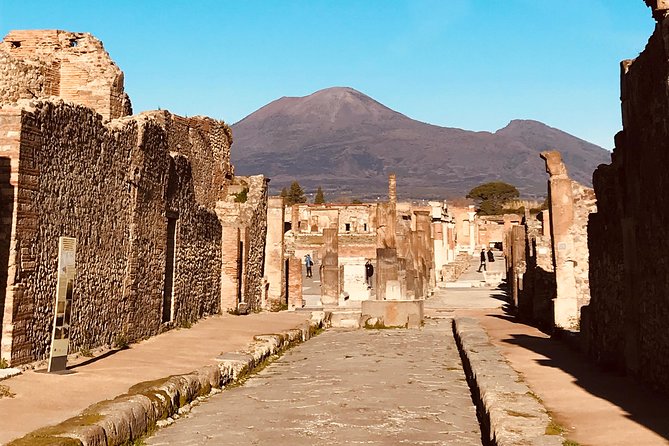
The Temple of Jupiter dominates the Forum’s northern side. Behind it, Mount Vesuvius provides the unforgettable reminder of what happened to the city. The view connects the ancient setting with the eruption without turning the stop into a simple disaster story.
Macellum and the plaster casts
The Macellum was a monumental food market where people bought daily goods. It gives you a direct link to ordinary urban life, since markets reveal what people ate, sold, and needed.
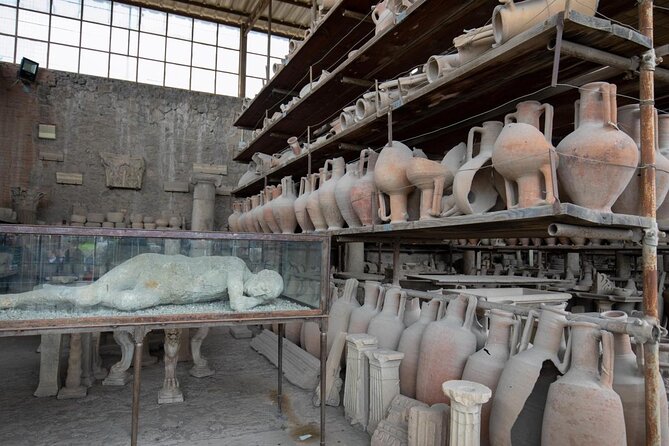
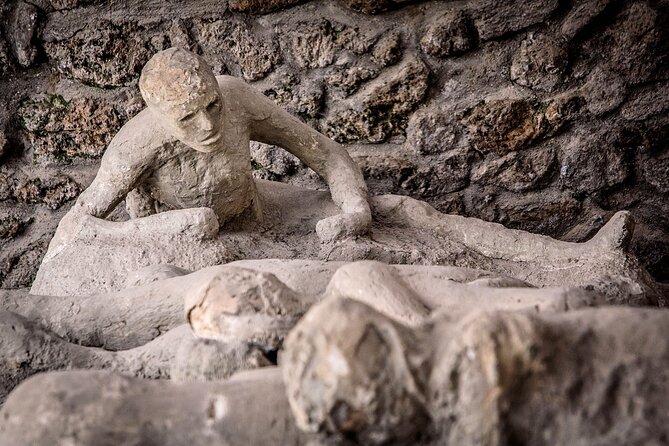
This is also where you may see plaster casts of victims. The casts come from an archaeological method used to preserve the shapes of bodies left in the ash and hardened volcanic material. The subject can be upsetting, but it is one of the clearest ways to grasp the human cost of the eruption.
A guide can explain how the casts were made and why archaeologists use the method. That is more meaningful than simply encountering them without warning or context.
The tour’s emphasis on how evidence is interpreted is one of its better features. You are encouraged to think about how researchers learn from buildings, objects, street plans, and physical traces, rather than treating every conclusion as a mystery.
Same place, a different kind of splurge:
- From Milan: Como, Lugano and Bellagio Exclusive Boat Cruise
★ 4.8 · 6,635 reviews - Legendary Venice: Doge’s Palace, St Mark’s & VIP Terrace Access
★ 4.5 · 5,033 reviews - From Naples: Exclusive Tour of Amalfi Coast
★ 4.8 · 3,970 reviews - Rome: Colosseum Arena, Roman Forum & Palatine Hill VIP Tour
★ 4.5 · 3,674 reviews
The Forum Baths and a Roman fast-food counter
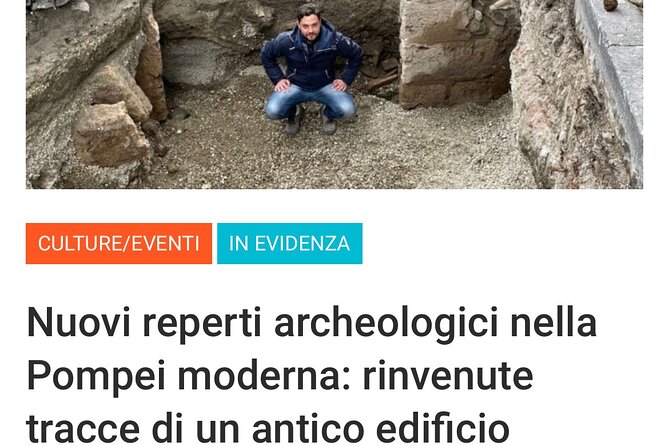
The Forum Baths are among Pompeii’s best-preserved buildings. Men’s and women’s areas had separate entrances, and the layout gives you a look at Roman bathing as a social and practical part of city life.
This stop also adds variety to the tour. After grand temples and public squares, the baths show a more intimate side of Roman routine. The preserved rooms help you picture how people moved through a public building and used its different spaces.
The thermopolium of Vetuzio Placido offers another change of scale. This was an old diner or refreshment counter for local residents. It is one of those places that makes Pompeii feel like a lived-in town rather than an open-air collection of monuments.
I find these modest commercial sites especially useful. A temple tells you about public belief. A diner tells you what people did when they needed food during the day. Together, the stops build a more complete picture of city life.
Private houses and seasonal openings
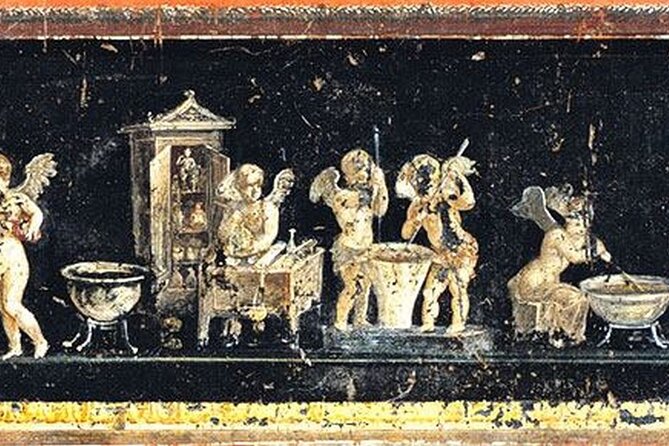
The House of the Faun is one of Pompeii’s largest private residences. Its sidewalk bears the Latin welcome inscription HAVE, an appealing detail that shows how even a short piece of paving can carry a human message.
The House of the Vettii is another major residence, associated with wealth and protected by Priapus, the god of prosperity. These homes can help you understand social difference, decoration, and the private side of Roman life.
There is an important qualification. Both houses are subject to seasonal opening and closing, so you should not assume that every departure will include interior access to both. The guide may explain the buildings even when a particular area is closed, but the exact route can change.
This is also the point where expectations matter. Pompeii covers far more than a two-hour visit can include. The tour is designed to show key areas, not every house, street, and public building.
Walking Via dell’Abbondanza
Via dell’Abbondanza was Pompeii’s ancient main street, known as the decumanus maximus. Walking along it helps you understand the scale of the city and the relationship between public buildings, private homes, shops, and traffic routes.
The ancient paving can be uneven, and the site includes plenty of open ground between stops. Wear comfortable walking shoes and expect the surface to demand more attention than a normal city sidewalk.
The route is not designed as a full archaeological survey. One account specifically noted that the amphitheater and brothels were not included, while the tour focused more on shops, houses, and bath rooms. If those locations are your main priority, ask the guide at the start or plan extra time after the guided walk.
That limitation is not necessarily a weakness. A short tour has to choose. The benefit is a manageable visit with a clear story instead of a rushed attempt to cover every corner.
Ending at the Teatro Grande
The final listed stop is the Teatro Grande, where comedies and tragedies were performed in the Greco-Roman tradition. It gives the tour a strong cultural ending, after the earlier focus on temples, commerce, bathing, and private homes.
The theater also reminds you that Pompeii was not only a place of work and worship. Entertainment, performance, and shared public experiences were part of urban life.
The tour returns to the meeting point. You can then continue exploring on your own if you still have energy and a valid site ticket. One useful feature of a two-hour route is that it leaves room for independent wandering rather than using your whole day on a guided schedule.
What the guide quality is like
The guide is the main reason to book this experience. The operator assigns authorized guides with archaeological expertise, and several named guides receive especially strong praise for their delivery.
Ricardo is described as excellent at answering questions and explaining how archaeologists identify the function of a building or interpret an object. Raffaele is praised for clear English, friendliness, and passion. Antonio is noted for making the walk personal and entertaining, while Ornella is praised for using stories and humor to explain Roman customs and daily life.
PierLuigi is also described as giving a thoughtful two-hour tour. In wet and windy weather, one guide reportedly used covered areas at the right moments while continuing the explanation. That suggests the guide may adapt the route and pacing to conditions, though weather remains a factor for this outdoor experience.
There is one warning about communication equipment. One person reported a faulty earpiece that was not replaced during the tour. Another praised a guide for speaking clearly without relying on distorted audio devices. If an earpiece is provided and it fails, tell the guide immediately and stay close enough to hear.
Group size, pace, and value
The advertised maximum is 15 people, which is a sensible size for Pompeii. You should have a better chance of hearing the guide than in a large coach group, and questions are less likely to disappear into a crowd.
One account reported a group of around 20, despite the stated maximum. That may have been an exception, but it is worth checking the group size when you arrive if this detail matters to you.
The tour lasts about two hours. That is long enough for a strong introduction but too short for a complete visit to Pompeii. I would treat it as an orientation walk, especially if this is your first time at the park.
At $30.25 per person, the guiding fee is reasonable for a specialist-led visit, but the full adult cost is higher once you add the €19 park ticket. The value depends on how much help you want interpreting the ruins. If you enjoy figuring out sites alone, you may prefer to buy admission and explore independently. If you want the city to make sense quickly, the guide adds real value.
The price is especially easy to justify for first-time visitors, families, and anyone with limited time. The tour can prevent you from spending your visit on the wrong streets or missing the meaning of buildings that look similar at first glance.
Who should book this Pompeii walk
I would choose this tour if you want a clear introduction, prefer a small group, and value archaeological explanation over simply taking photographs. It also suits families, since several guides use questions, stories, and humor to keep the pace lively.
It works well for people coming from Naples or nearby, as the meeting point is near public transportation. Most people can participate, but the amount of walking and uneven paving make sensible shoes important.
You should look elsewhere if your top priority is the amphitheater, brothels, or a particular house that may be closed seasonally. You may also want a longer private tour if you need a custom route or more time for detailed photography.
Free cancellation is available up to 24 hours before the start time. Late cancellations are not refunded, and the operator may offer a new date or a full refund if poor weather or insufficient bookings force cancellation.
Should you book it?
I would book this tour for a first visit to Pompeii, especially if you have only a few hours. The combination of an archaeologist, a focused route, and a small group gives you a useful framework for understanding the site.
Just budget separately for the €19 adult entry ticket, arrange admission before the meeting time if possible, and accept that two hours covers highlights rather than the whole city. If those limits suit your plans, this is a practical way to make Pompeii feel like a real town instead of a confusing field of ruins.
FAQ
How long does the Pompeii tour last?
The tour lasts approximately two hours.
What language is the tour offered in?
The tour is offered in English.
Is the Pompeii entrance ticket included?
No. The tour price does not include admission to Pompeii Archaeological Park. The listed adult admission is €19, while entry is free for visitors under 18.
Where does the tour meet?
The meeting point is at Via Villa dei Misteri 1, 80045 Pompei, Italy. The guide waits outside the archaeological park at Porta Marina Superiore with a Pompeii Vip sign.
How large is the tour group?
The stated maximum is 15 people. One account reported a group of about 20, so you may wish to confirm the group size when you arrive.
Which Pompeii sights are included?
The route includes Porta Marina Superiore, the Temple of Venus, Basilica, Sanctuary of Apollo, Forum, Temple of Jupiter, Macellum, Forum Baths, the thermopolium of Vetuzio Placido, Casa del Fauno, the House of the Vettii, Via dell’Abbondanza, and Teatro Grande. The route can vary, and the two private houses are subject to seasonal openings and closures.
Are comfortable shoes necessary?
Yes. Pompeii involves considerable walking on uneven ancient surfaces, so comfortable walking shoes are strongly recommended.
Can I cancel for a full refund?
You can cancel for a full refund up to 24 hours before the experience start time. Cancellations or changes made less than 24 hours before the start are not refunded. If poor weather or insufficient bookings causes the operator to cancel, you may be offered another date or a full refund.
Just added around Italy
- Three Hour Private Guided Tour of Capri with a luxury Gozzo cabin cruiser★ 5.0 · 15 reviews
- Capri Secret Corners by Boat Premium Tour with Local Captain★ 4.5 · 50 reviews
- Cagliari 3 Hours Luxury Motorboat Tour – Wine and Snorkeling★ 5.0 · 118 reviews
- Exclusive Picnic in the Foothills of the Alps with the Lake Views★ 5.0 · 74 reviews
- Skip the line with exclusive entrance to the Pantheon★ 4.5 · 20 reviews
- Polignano a Mare luxury boat tour, aperitif, diving and snorkeling★ 5.0 · 51 reviews
- Luxury Shared Boat Tour in Polignano a Mare with Local Aperitif★ 5.0 · 30 reviews
- Pic nic Deluxe Assisi for 2 and wine tasting 5 wines★ 5.0 · 63 reviews
Italy VIP Tours, compared.
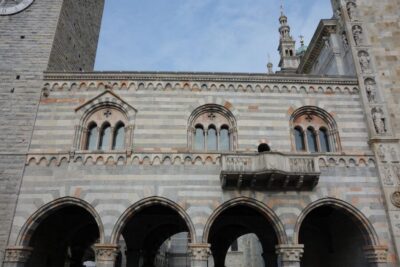
From Milan: Como, Lugano and Bellagio Exclusive Boat Cruise
Read our review →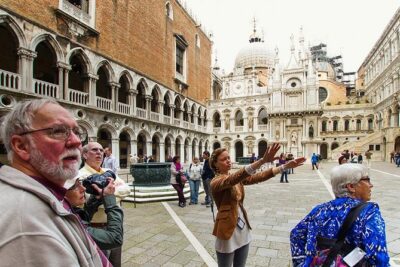
Legendary Venice: Doge’s Palace, St Mark’s & VIP Terrace Access
Read our review →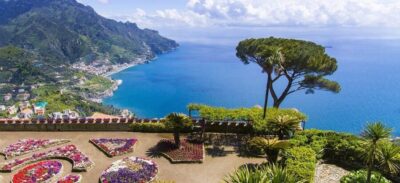
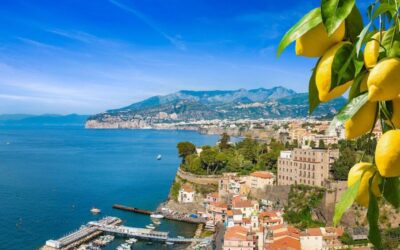
From Naples: Premium Tour of Sorrento, Positano, Amalfi
Read our review →
Sorrento: Exclusive Capri Boat Tour and Optional Blue Grotto
Read our review →
VIP Vatican Breakfast and Guided Tour with Sistine Chapel Access
Read our review →
Colosseum, Roman Forum & Palatine Hill Guided Tour
Read our review →
Florence: Premium Pizza & Gelato Preparation Class with Wine
Read our review →Browse the lists this tour appears in