
Review · ATHENS
Mycenae Epidaurus Nafplio Isthmus Canal Private Luxury Tour
The star of this long day is the sweep of ancient Greece packed into one private drive: the Lion Gate at Mycenae, the near-perfect theater at Epidaurus, and the seafront town of Nafplio. You also get the quick, worthwhile stop at the Corinth Canal, where ships pass through a narrow cut between the mainland and the Peloponnese.
I like the door-to-door pickup and the freedom to change the plan. Past drivers such as Andreas, Ioannis, Chris, and Theodore have been praised for safe driving, good restaurant advice, and lively storytelling. The catch is the pace: nine hours and 15 minutes is tight for four major stops, and a history-minded day can stretch to 11 hours.
Key points at a glance
- The Corinth Canal saves you a long detour: Spend about 15 minutes seeing the waterway that cuts across the Isthmus of Corinth.
- Mycenae gives you the strongest ancient-site experience: Walk through the Lion Gate, see the Cyclopean walls, and visit the nearby Treasury of Atreus.
- Epidaurus is more than a theater: The sanctuary of Asklepios and its small archaeological museum explain why this was an ancient center of medicine.
- Nafplio breaks up the ruins: Use free time for lunch, coffee, shopping, the harbor, and views toward Bourtzi.
- The tour is genuinely private: Groups of one to three use a luxury sedan, while groups of four to seven use a private minivan.
- Budget for admissions: Archaeological entry fees, the museums, Palamidi Castle, lunch, and gratuities are not included.
Why this private Peloponnese day trip works
This is a road trip for people who want to see several major places without renting a car or working out Greek bus connections. Your driver collects you at your Athens hotel, apartment, or port, then brings you back to the same place or another agreed drop-off point.
The private format matters. You can ask to spend more time at Mycenae, shorten Nafplio, or replace Epidaurus with another stop such as Ancient Corinth. One family used that flexibility to visit Ancient Corinth instead of Epidaurus and found they wanted even longer there.
You should also understand the role of the driver. The English-speaking drivers have historical knowledge and can explain what you are seeing, but they are not automatically licensed archaeological guides. If you want formal site commentary inside Mycenae or Epidaurus, you need to arrange a licensed guide at an additional cost.
The vehicles come with air-conditioning, Wi-Fi, bottled water, fuel, and tolls. Groups of one to three ride in a luxury sedan, while four to seven use a minivan. A child seat can be requested in advance.
A few more luxury tours around Athens worth a look
- Acropolis: Premium Acropolis and Parthenon Guided Tour
★ 4.8 · 5,208 reviews - Luxury Catamaran Cruise from Athens with Traditional Greek Meal and BBQ
★ 5.0 · 1,346 reviews - Hydra, Poros and Egina Day Cruise from Athens with Optional VIP Upgrade
★ 4.0 · 1,310 reviews
The Corinth Canal: a sharp 15-minute stop
The Corinth Canal is a quick photo stop, but it gives the day a useful geographical opening. The cut links the Gulf of Corinth with the Saronic Gulf, reducing the need for ships to circle the Peloponnese by roughly 185 nautical miles.
The idea is much older than the canal itself. Periander, the ruler of Corinth in the sixth century BC, is said to have considered cutting through the isthmus. Instead, ancient engineers built the diolkos, a stone track used to move ships overland on wheeled platforms. The modern canal was completed in the late 19th century.
You will have about 15 minutes here, so think of it as a leg-stretch and orientation stop rather than a full visit. The canal separates mainland Greece from the Peloponnese in practical terms, and the narrow walls make a striking photograph.
Mycenae and the Lion Gate: the day’s ancient highlight
Mycenae sits in the hills of the Argolid, above the agricultural countryside. It gave its name to the Mycenaean civilization, which flourished roughly from 1600 to 1100 BC and reached its height around 1350 BC.
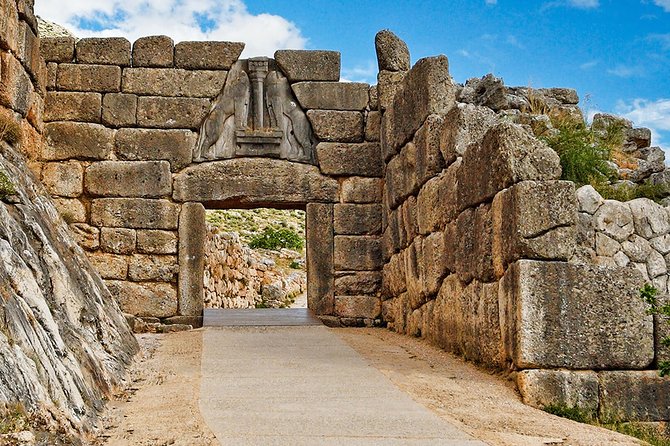
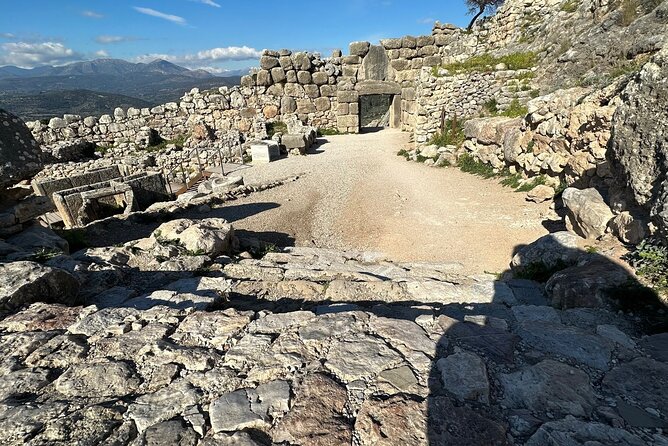
The approach helps explain why this place mattered. The citadel was built as a military center, with massive Cyclopean walls surrounding the acropolis. The name comes from later Greeks who thought the stones were too large for ordinary humans to move.
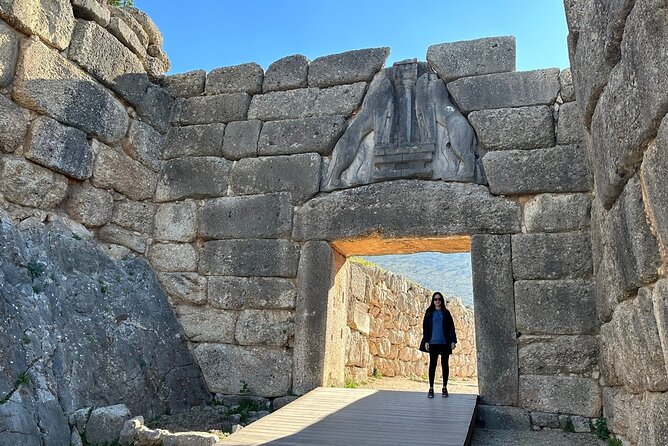
You enter through the Lion Gate, built around 1250 BC. Two lion or lioness figures face one another above the entrance, set into the triangular space over the doorway. It is the best-known surviving piece of Mycenaean monumental sculpture and gives the entrance a force that photographs do not quite capture.
Allow about an hour for the main site. You can see the fortified acropolis, sections of the walls, funerary areas, and the remains of the settlement below. The ground is uneven in places, and the site is exposed, so practical shoes, sun protection, and water are useful.
The name Agamemnon is attached to Mycenae through Greek myth, but the archaeological site is valuable even if you set the legends aside. You are looking at the political center of a civilization that controlled much of southern Greece, Crete, the Cyclades, and parts of southwest Anatolia.
The nearby Tomb of Clytemnestra adds another connection to the stories of the royal family. The site works best when your driver gives a short explanation before you explore, then lets you move at your own pace.
The Treasury of Atreus and the Mycenae museum
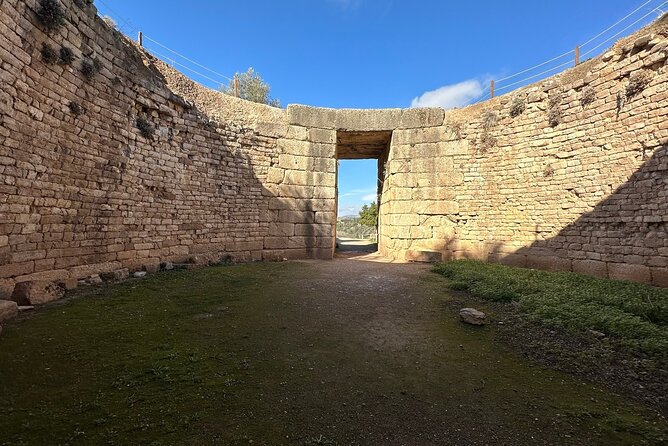
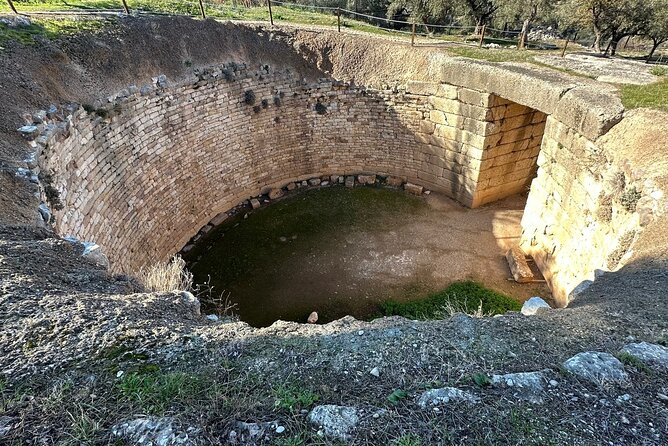
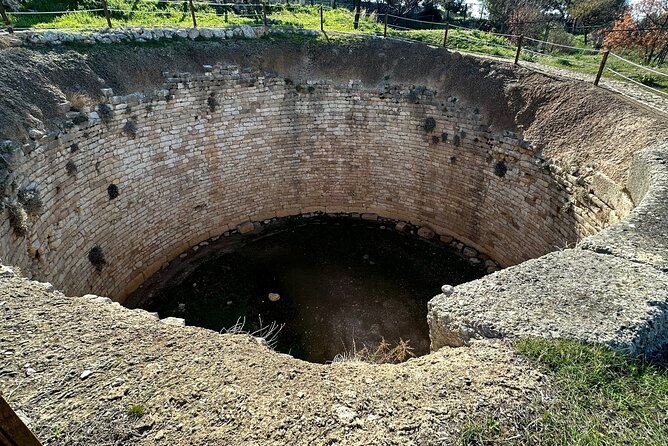
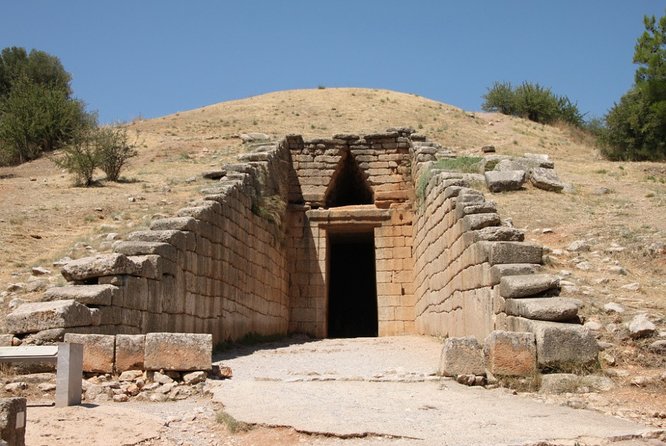
The Treasury of Atreus, also called the Tomb of Agamemnon, is a short stop away from the citadel. This large tholos tomb has a beehive-shaped interior made from carefully placed stone courses.
The doorway is especially impressive. Its lintel weighs about 120 tons and measures roughly 8.3 by 5.2 by 1.2 meters. You only need about 15 minutes to enter, look up, and grasp the scale of Bronze Age engineering.
The Archaeological Museum of Ancient Mycenae adds objects and context that the open-air ruins cannot provide. It covers the kingdom associated with Agamemnon and the wider Mycenaean civilization. Plan about 45 minutes if you want more than a quick look.
Admission costs are not included. The stated entry fee for the Mycenae archaeological site is €20 per person, while the museum is also excluded from the tour price. Check the current charges when booking, since the supplied pricing information does not give a separate museum amount.
Same place, a different kind of splurge:
- Premium Delphi Day Trip with an Expert Guide, Museum & Lunch
★ 4.5 · 1,100 reviews - Athens Pub Crawl with 1hr Open Bar & VIP Nightclub Access
★ 4.7 · 794 reviews - Athens Pub Crawl with 1hr Open Bar & VIP Nightclub Access
★ 5.0 · 486 reviews - PREMIUM Semi-Private Athens Afternoon Food Tour & Wine Tasting
★ 5.0 · 363 reviews
Epidaurus: theater, healing, and ancient medicine
Epidaurus shifts the mood from fortified power to ritual and care. The sanctuary was dedicated to Asklepios, the ancient Greek god of medicine, and became one of the most important healing centers in Greece.
The Ancient Theatre of Epidaurus is the main reason to come. Its three-part structure includes the seating area, orchestra, and stage building. Unlike many Greek theaters, it was not significantly changed during the Roman period.
The acoustics are the famous feature. A coin or small object dropped at the center can be heard from the upper seats, according to the standard demonstration at the site. You will have about 30 minutes at the theater itself, which is enough to test the sound and walk around, but not enough for a slow study of every detail.
The broader Epidaurus stop is listed at about an hour. That time includes the theater and parts of the sanctuary, though the exact balance depends on your driver and your choices. If you want the archaeological museum as well, plan for the additional 30-minute visit and its separate admission.
The Sanctuary of Asklepios helps explain the theater’s setting. This was not simply a performance venue isolated in the hills. The site included religious buildings, healing facilities, monuments, and spaces connected with the worship of Asklepios.
The Epidaurus museum and sanctuary
The Archaeological Museum of Epidaurus opened in 1909 and contains architectural pieces from the sanctuary, inscriptions, altars, bronze medical tools, sculptures, pottery, and votive objects. Reconstructions of temples and sections of the Tholos make the museum useful before or after you walk through the ruins.
I would not treat this as an optional extra if ancient medicine interests you. The open site gives you columns and foundations, while the museum helps show how the buildings looked and what activities took place there.
The museum and Sanctuary of Asklepios have separate admission arrangements from the private transport. The tour price does not include the Epidaurus Archaeological Museum, and the Ancient Theatre of Epidaurus is also listed as an additional €20 per person.
The itinerary includes the Ancient Theatre of Epidaurus twice, once within the Epidaurus visit and again as a final listed stop. In practical terms, you should expect one Epidaurus section, not two separate theater visits.
Nafplio: a welcome break after the ruins
Nafplio is the day’s change of rhythm. This attractive port town sits at the north end of the Argolic Gulf and served as the capital of the first Hellenic Republic and the early Greek kingdom.
Your free time is intended for lunch, coffee, shopping, and a walk through the old town. The schedule allows about 90 minutes in one part of the itinerary and another hour later, though private touring means you can discuss how to use that time.
The town also has several quick sights. The Lion of the Bavarians is carved into the rock above Michael Iatrou Street. The sleeping lion commemorates Bavarian soldiers from the dynasty of King Otto who died in Nafplio during a typhoid epidemic in 1833.
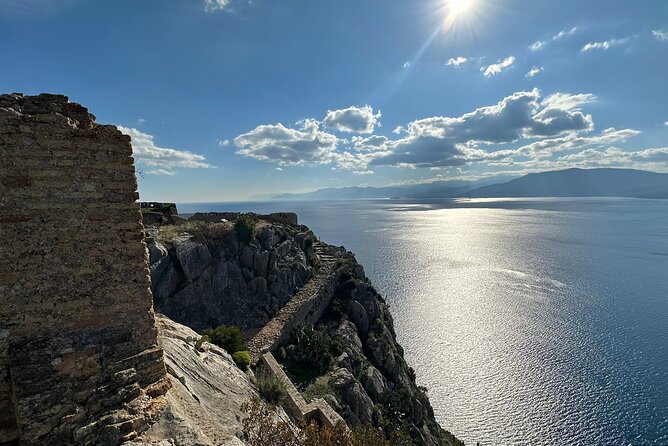
Palamidi Castle sits high above town on a 216-meter hill. The fortress was built by the Venetians during their second period of control, from 1686 to 1715. The views toward Nafplio and the Argolic Gulf are a strong reason to go up, but the climb from town involves 913 winding steps, with local tradition putting the total at 999.
The tour allows about 30 minutes at Palamidi. That is enough for a quick look and views, but not a full exploration of every fortification. Entry is not included and is listed at €20 per person.
Akronafplia is the oldest part of Nafplio. You get only about 10 minutes here, so expect a short viewpoint or orientation stop rather than a full visit.
Bourtzi, the Venetian water castle in the harbor, is another photo stop. The itinerary allows about 10 minutes from the harbor side, and boat access is not included. From shore, you can still get a good sense of its position guarding the entrance to the port.
Timing, comfort, and the real cost
The advertised duration is about nine hours and 15 minutes, but I would keep your schedule flexible. One detailed day with four people ran to about 11 hours because the group spent extra time at the historic sites, dealt with traffic, and stayed in central Athens near the Ancient Agora.
That is not a fault, but it is important if you have an evening flight, dinner reservation, or cruise departure. Tell the operator about any hard deadline before setting off.
At $167.59 per person, the price is not the cheapest way to reach the Peloponnese. It becomes more reasonable when split among a private group, since transport, tolls, fuel, bottled water, Wi-Fi, and hotel or port pickup are included.
You still need to add admissions. The listed fees include €20 per person for Mycenae, €20 for the Ancient Theatre of Epidaurus, and €20 for Palamidi Castle. Museum admission, lunch, and tips are extra. Airport pickup also costs an additional €60 per person.
The value is greatest when you care about convenience and control. If you only want a single archaeological site, public transport or a basic transfer may cost less. If you want Mycenae, Epidaurus, Nafplio, and the Corinth Canal in one day without driving, the private arrangement earns its keep.
What the drivers add, and where to set expectations
The strongest driver experiences described for this tour came from Andreas, Ioannis, Chris, Theodore, and another driver named Kristos. Andreas was praised for practical help, safe driving, and adjusting the day, including a sunscreen stop and a change to Ancient Corinth. Ioannis was noted for helping with site navigation and restaurant advice, while Chris was described as entertaining and good at explaining Greek myths.
Those names do not mean you can assume a particular driver will be assigned. They show the level of service the company has provided on different departures.
You should ask questions if you want more historical detail. The drivers can share information, but the tour does not automatically include a licensed guide inside the archaeological sites. One poor experience involved a passenger who felt the driver offered too little explanation without prompting, while other departures received strong praise for storytelling.
This is a good reason to decide what you want before pickup. Tell the driver if you prefer a quiet scenic drive, a fast site visit, or detailed explanations at every stop.
Who should book this day trip?
I would choose this tour for a first visit to the Peloponnese when you have only one free day from Athens. It suits couples, families, cruise passengers, and small groups who want a private vehicle and a flexible plan.
It is also a good match for people who value comfort over the lowest possible price. Pickup can be arranged at a hotel, apartment, port, or airport, and the driver returns you to the agreed location.
I would hesitate if you dislike full days on the road or prefer to study one ruin at length. Mycenae, Epidaurus, Nafplio, and the canal make a full program, and the schedule can feel compressed. A private tour lets you remove stops, but the base plan asks you to cover a lot.
Free cancellation is available up to 24 hours before the start time. The experience requires suitable weather, and a weather cancellation offers a new date or a full refund.
Should you book the Mycenae and Nafplio tour?
Book it if you want a private, efficient introduction to the Argolid and you accept that the day will be long. Mycenae is the strongest archaeological stop, Epidaurus brings a remarkable theater and sanctuary, and Nafplio gives you food and town time between the ruins.
Before booking, confirm which admissions you plan to pay, request a licensed guide if detailed site interpretation matters, and tell the operator about any fixed return time. If your group prefers a slower day, use the private format to drop one stop rather than trying to see everything at top speed.
FAQ
Where does the tour begin and end?
Pickup and return can be arranged at an Athens hotel, apartment, port, or another agreed location. Airport pickup is available for an additional €60 per person.
How long does the tour last?
The stated duration is approximately nine hours and 15 minutes. A detailed day can take about 11 hours, especially with traffic and longer visits at the archaeological sites.
Is this a private tour?
Yes. Only your group participates. Groups of one to three use a luxury sedan, and groups of four to seven use a private minivan.
Is a licensed archaeological guide included?
No. The English-speaking driver can provide historical information, but a licensed guide is an optional extra.
Are entrance fees included?
No. Mycenae, the Ancient Theatre of Epidaurus, Palamidi Castle, and the archaeological museums are not included in the tour price. The stated fees for Mycenae, Epidaurus theater, and Palamidi are €20 per person each.
Is lunch included?
No. The itinerary includes free time for lunch in Nafplio, but you pay for your own meal.
Can the itinerary be changed?
Yes. The tour is private and can be adjusted to your needs. A previous departure replaced Epidaurus with Ancient Corinth, and another group skipped Mycenae because of limited time.
Just added around Athens
- VIP – Day Cruise From Athens to Hydra Poros Aegina★ 4.5 · 28 reviews
- VIP Private Guided Tour of Athens Acropolis & Plaka in a Sidecar★ 5.0 · 108 reviews
- Athens: Premium Guided E-Scooter Tour in Acropolis Area★ 5.0 · 133 reviews
- VIP Day Cruise from Athens to Hydra, Poros and Aegina★ 4.5 · 58 reviews
- Private Luxury Powerboat Day Tour in Athens★ 5.0 · 36 reviews
- Private Sunset Sounio By Athenian Riviera With Acropolis Visit★ 4.5 · 27 reviews
- Private Luxury Tour: Unveiling the Sacred Mysteries of Eleusis★ 5.0 · 45 reviews
- Private Luxury Tour: Mystic Pilgrimage – Kerameikos to Eleusis★ 5.0 · 20 reviews
Athens VIP Tours, compared.
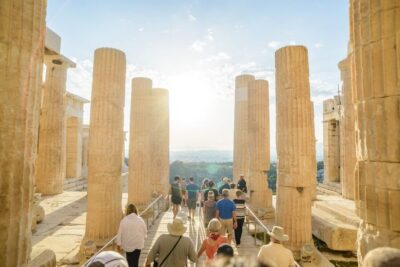
Acropolis: Premium Acropolis and Parthenon Guided Tour
Read our review →
Luxury Catamaran Cruise from Athens with Traditional Greek Meal and BBQ
Read our review →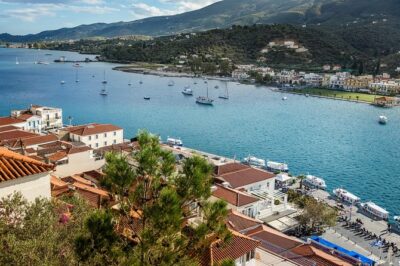
Hydra, Poros and Egina Day Cruise from Athens with Optional VIP Upgrade
Read our review →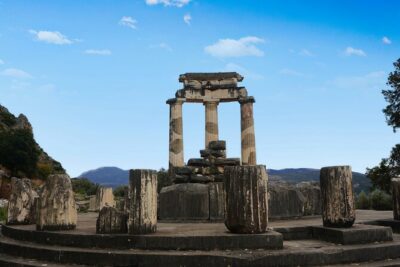
Premium Delphi Day Trip with an Expert Guide, Museum & Lunch
Read our review →
Athens Pub Crawl with 1hr Open Bar & VIP Nightclub Access
Read our review →Athens Pub Crawl with 1hr Open Bar & VIP Nightclub Access
Read our review →
PREMIUM Semi-Private Athens Afternoon Food Tour & Wine Tasting
Read our review →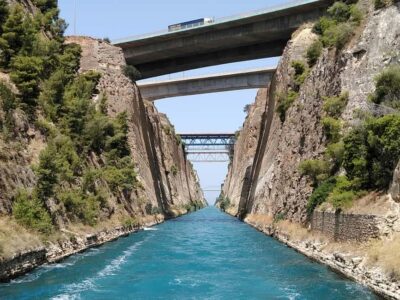
Athens: Corinth Canal, Mycenae & Nafplio Premium Guided Tour
Read our review →Browse the lists this tour appears in