
Review · ATHENS
Biblical Ancient Corinth Canal Epidaurus Nafplio Private Tour
The big appeal here is the amount of Greece you can cover in one day: the Corinth Canal, the ruins of Ancient Corinth, the theater of Epidaurus, and handsome Nafplio. You get a private vehicle, hotel or port pickup, and a day shaped around your group rather than a fixed coach schedule.
I like the flexibility, especially after hearing how drivers such as Giannis, Themos, and Chris adjusted the route, added stops, and helped with practical needs. I also like the comfort: air-conditioning, bottled water, WiFi, and a sedan or minivan make a long summer day far easier.
The trade-off is time. This is an ambitious itinerary, and entrance fees are extra. If you want serious archaeological explanation at every site, budget for licensed guides or accept that your driver’s commentary will be more general.
Key points to know before booking
- The Corinth Canal is a quick but memorable first stop: Allow about 20 minutes for views of the narrow waterway.
- Ancient Corinth gives you several sites in one area: Plan for the ruins, museum, Temple of Apollo, and Acrocorinth.
- Epidaurus has the day’s star attraction: Its ancient theater is famous for remarkable acoustics and graceful design.
- Nafplio adds a welcome change of pace: Use your free time for lunch, coffee, shopping, and harbor views.
- The tour is genuinely private: Groups of one to three use a sedan, while four to seven use a minivan.
- The cost is not all-inclusive: Admission, lunch, tips, and a licensed guide are separate expenses.
A long but rewarding day from Athens
At $240.93 per person, this is not a budget bus outing. It is a private full-day drive through the northeastern Peloponnese, with pickup and drop-off at your Athens hotel, apartment, or port. Airport pickup is also possible for an added charge.
The value depends on your group. For two people, the price buys privacy, door-to-door service, and the freedom to alter the day. For a larger group, the per-person cost can make more sense, especially since the vehicle, fuel, tolls, bottled water, and driver are included.
The schedule is listed at about eight and a half hours. That is enough for a strong overview, but not enough for a slow archaeological study of every stop. Driving between Athens, Corinth, Epidaurus, and Nafplio takes a large part of the day. You will need to keep an eye on the clock if you want to see all the major points.
That is where the private format helps. If one person wants more time at the ruins, another needs shade, or your group prefers lunch over one short photo stop, the driver can adjust the program. Chris, Themos, and Giannis are specifically associated with flexible, attentive service, and that matters on a day with this many moving parts.
Other VIP and luxury tours people book around Athens:
- Acropolis: Premium Acropolis and Parthenon Guided Tour
★ 4.8 · 5,208 reviews - Luxury Catamaran Cruise from Athens with Traditional Greek Meal and BBQ
★ 5.0 · 1,346 reviews - Hydra, Poros and Egina Day Cruise from Athens with Optional VIP Upgrade
★ 4.0 · 1,310 reviews
The Corinth Canal: a short stop with a big idea
The Corinth Canal is the natural opening act. It cuts through the Isthmus of Corinth and links the Gulf of Corinth with the Saronic Gulf. In practical terms, it separates the mainland from the Peloponnese, making the southern peninsula an island.
The modern canal dates from the late nineteenth century, but the idea is much older. Ships once had to sail around the Peloponnese, adding roughly 185 nautical miles to the trip. Periander, the tyrant of Corinth, is said to have considered digging a canal around 602 BC. Without the engineering to cut through the isthmus, he used the diolkos, a stone route that allowed ships to be hauled across on wheeled platforms.
You have about 20 minutes here. That is enough to look down into the narrow cut, take photographs, and understand why this strip of land mattered so much. It is not a full canal cruise, and admission is free, so treat it as a sharp, useful introduction rather than a major sightseeing stop.
Ancient Corinth and the world of Saint Paul
Ancient Corinth is the first substantial archaeological stop. The city occupied the isthmus between mainland Greece and the Peloponnese, roughly between Athens and Sparta. Its position made it a commercial and strategic power.
The scale was impressive. Corinth may have had about 90,000 people in 400 BC. Rome destroyed the city in 146 BC, then rebuilt it in 44 BC. Under Roman rule, it became the provincial capital of Greece.
For Christian visitors, Corinth has an additional layer of meaning. The city is linked to the First and Second Letters to the Corinthians, and the Acts of the Apostles describes Paul’s missionary work there. Even if you are more interested in classical ruins than biblical history, that connection gives the site another way into the past.
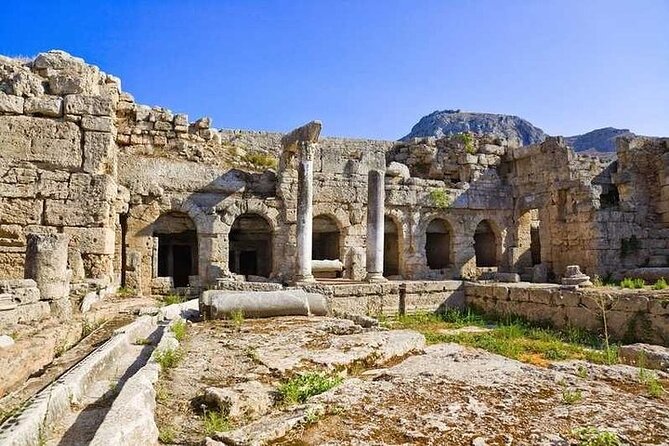
Allow about 90 minutes for Ancient Corinth. You can see the Agora, the Lechaion Road, the Fountain of Peirene, the theater, basilica remains, the Odeion, the Stoa, and other temples. The ruins are spread across an open archaeological area, so comfortable shoes, water, and sun protection are sensible.
The entrance fee for Ancient Corinth is listed as €15 per person. That does not include a licensed guide. Your English-speaking driver can explain the broad story, but a guide inside the archaeological area would give you more context about how the buildings worked together.
The Corinth Museum and Temple of Apollo
The Archaeological Museum of Ancient Corinth sits within the archaeological site. It was built in 1931 and 1932 to display finds from the excavations. Its 40-minute visit can help you make sense of the broken columns and foundations outside.
The museum is especially useful if you like details that do not survive in the open air. Sculptural pieces, inscriptions, and objects from the city give you a clearer sense of Corinth as a functioning place, not simply a field of stones.
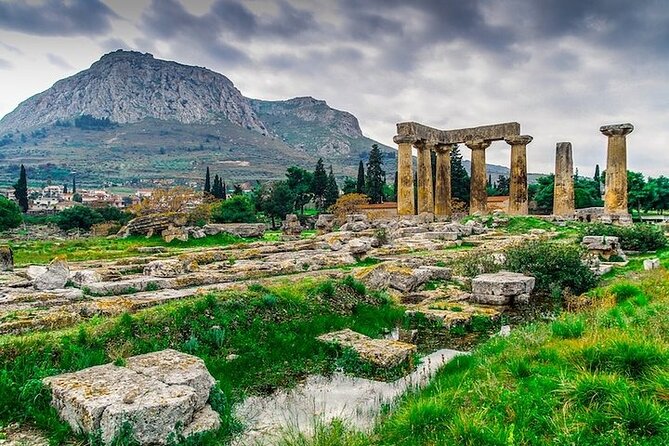
The Temple of Apollo is a quick 10-minute stop. Built around 550 BC, it is one of the earliest Doric temples in the Peloponnese and on the Greek mainland. Its monolithic columns are a striking feature, and even a short look helps you understand the severe, solid style of early Greek temple design.
Admission to the museum is not included, and the supplied pricing does not specify a separate museum fee. Check the current combined or separate ticket arrangements when booking your day.
Same place, a different kind of splurge:
- Premium Delphi Day Trip with an Expert Guide, Museum & Lunch
★ 4.5 · 1,100 reviews - Athens Pub Crawl with 1hr Open Bar & VIP Nightclub Access
★ 4.7 · 794 reviews - Athens Pub Crawl with 1hr Open Bar & VIP Nightclub Access
★ 5.0 · 486 reviews - PREMIUM Semi-Private Athens Afternoon Food Tour & Wine Tasting
★ 5.0 · 363 reviews
Acrocorinth: history with a climb
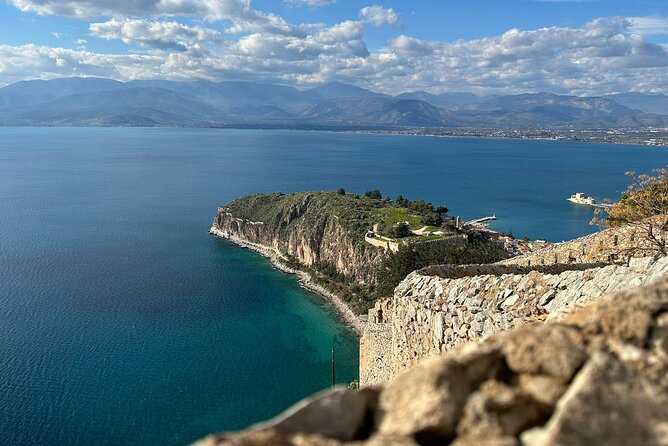
Acrocorinth, or Upper Corinth, rises on a large rock above the ancient city. Its height and water supply made it a powerful defensive position. The fortress controlled access through the isthmus and served as a final line of defense in southern Greece.
You have about 30 minutes here. That is enough for a viewpoint and a quick look, but not a long exploration of every fortification. Depending on where the vehicle stops and how much walking your group prefers, this may feel like a brisk visit.
This is one of the places where the private format helps less if your group wants a full fortress walk. The schedule has several more stops ahead, so tell the driver early if Acrocorinth is a priority. If you are traveling with older family members or anyone who tires easily, use the available time for the view rather than trying to cover every path.
Epidaurus and the ancient medicine of Asclepius
Epidaurus changes the mood of the day. The site was centered on Asclepius, the ancient Greek demi-god of medicine, and functioned as a sanctuary and medical retreat. The Temple of Asclepius was built in the early fourth century BC.
The sanctuary was important enough to rival major religious centers connected with Zeus at Olympia and Apollo at Delphi. The site shows how ancient medicine, religion, ritual, and theater could occupy the same world. People came to seek healing, but the sanctuary also had buildings, ceremonies, and performances.
The itinerary allows about an hour for Epidaurus, followed by separate time for the museum, sanctuary, and theater. The archaeological area is exposed, so summer heat can affect how much you enjoy the visit. The vehicle’s air-conditioning and bottled water are not minor comforts here.
The Epidaurus Museum and Sanctuary of Asclepius
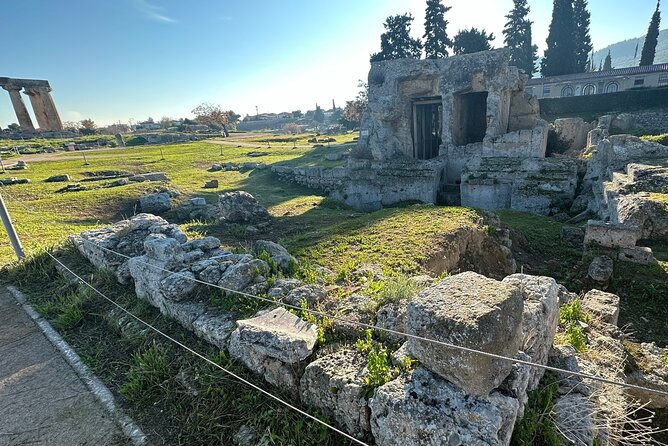
The Archaeological Museum of Epidaurus opened in 1909 after being established in the early twentieth century. It is noted for reconstructions of temples, columns, and inscriptions found at the site and in the surrounding area.
A 30-minute museum visit is enough for an introduction. It may be more valuable to you after seeing the sanctuary, since you can recognize architectural pieces and understand where they belonged. The museum entrance is not included.
The Sanctuary of Asclepius is allotted about 15 minutes in the schedule. That is brief, so expect an overview rather than a close study of every structure. The Temple of Asclepius is the key point, but the wider sanctuary is what explains the site’s importance as a place of healing.
The Ancient Theatre of Epidaurus
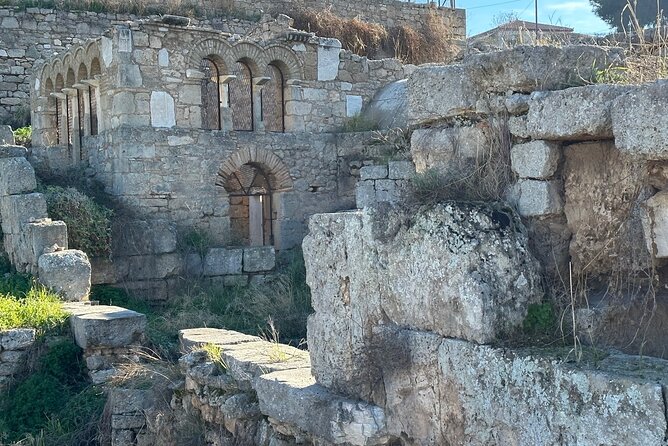
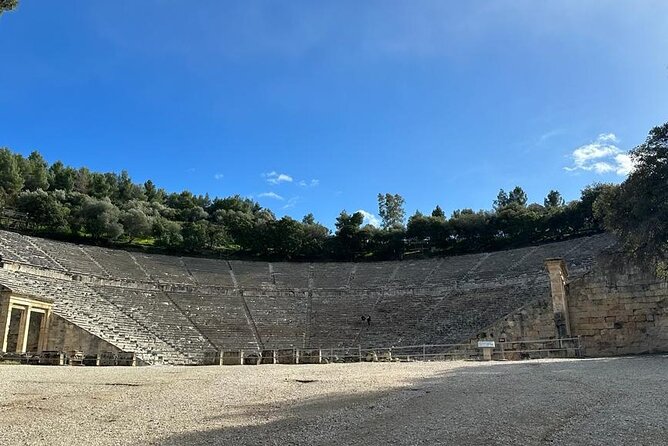
The theater is the most memorable stop for many people. Built on the west side of Cynortion Mountain, it has the classic Greek arrangement of theatron, orchestra, and skene. Its design and acoustics are considered exceptional.
The usual demonstration is simple: stand or sit in the orchestra and make a small sound while someone listens from the upper seats. The theater’s shape carries sound remarkably well. The point is not just the trick. It shows that ancient architects understood proportion, sightlines, and public space with great precision.
You have about 45 minutes here. Walk up far enough to appreciate the full curve, then look back toward the orchestra and stage building. The theater is not only a photo stop. It is a place where the physical design still explains the purpose of the building.
Entrance to the archaeological site is not included, and the listed fee for the Archaeological Site of Epidaurus is €20 per person. If you want detailed explanations of the sanctuary and theater, a licensed guide is worth considering. One past assessment of this tour specifically advised hiring a guide at the sites for more context.
Nafplio: lunch, coffee, and a change of pace
Nafplio is the breathing space in the itinerary. This seaport town on the Argolic Gulf served as the capital of the First Hellenic Republic and later the Kingdom of Greece during the early years of the modern Greek state.
Your free time is scheduled for lunch, coffee, and shopping. Lunch is not included, but the driver can point you toward a suitable stop. Giannis was praised for showing a group a particularly good lunch place, and that kind of local help is useful when you have only about an hour.
Nafplio is also a practical break after several archaeological sites. You can eat, sit in the shade, browse shops, or simply enjoy the harbor before returning to fortifications and viewpoints. If food matters to you, tell the driver early so lunch does not get squeezed into the last few minutes.
The Lion of the Bavarians and Nafplio’s memorials
The Lion of the Bavarians is carved into rock above Michael Iatrou Street. The sleeping lion commemorates Bavarian soldiers from the dynasty of Otto, who died in Nafplio in 1833 during a typhoid epidemic.
It is a short, unusual stop that adds a later chapter to the town’s story. You do not need much time here, but the monument is large and striking, with a small park below it. The stop is free and works well before or after your central Nafplio break.
Palamidi Castle and the view over Nafplio
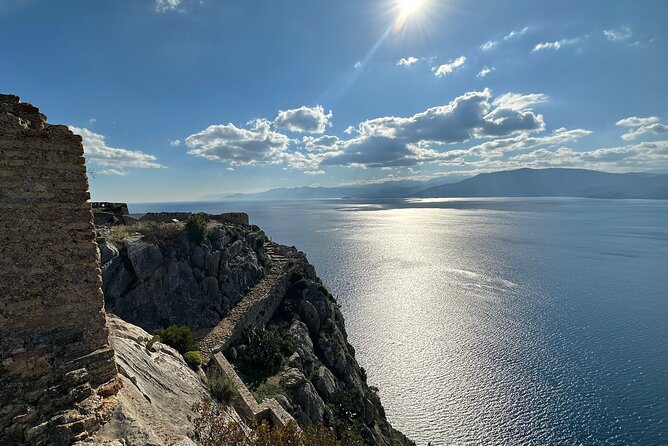
Palamidi Castle sits on a 216-meter-high hill above Nafplio. The Venetians built the fortress during their second period of control, from 1686 to 1715. Its walls command views across the Argolic Gulf, the town, and the surrounding countryside.
The famous count is 913 steps from town to the fortress, although local tradition often rounds the number to 999. If you arrive by vehicle near the upper entrance, you avoid the full stair climb, but the fortress itself still involves uneven ground, slopes, and walking.
The schedule allows 30 minutes. That gives you time for views and a quick look at the fortifications, not a full examination of the complex. Palamidi admission is listed at €20 per person.
The fortress also connects with the story of Kolokotronis, whose prison is located within the site. If you want to explore the fort at length, ask about changing the balance of the day. You may need to shorten another stop.
Akronafplia and Bourtzi from the harbor
Akronafplia is the oldest part of Nafplio. It was once a town of its own, then became part of the city’s defenses under Frankish and Venetian rule. Parts of the area later served as a prison.
The itinerary does not give a separate duration for Akronafplia, so treat it as a viewpoint or drive-by addition unless you arrange more time. Its position gives you a useful look at how Nafplio’s fortifications fit together.
Bourtzi is the small Venetian water castle in the harbor. You will view it from the waterfront and take photographs rather than visit the island fortress. The listed stop is about 10 minutes, and admission is not included.
Transport, group size, and what is included
Pickup is available from an Athens hotel, apartment, or port. For a hotel, the driver waits in the lobby. At an apartment, the meeting point is the building entrance. Port pickup takes place at the gate with a sign, and airport pickup can be arranged at an added cost.
Groups of one to three use a luxury sedan. Groups of four to seven use a minivan. Every vehicle has air-conditioning, WiFi, and bottled water. Child or infant seats are available if requested in advance.
The tour includes fuel and tolls, which matters on a long driving day. It does not include meals, archaeological admission, tips, or a licensed guide. The English-speaking driver provides historical information, but that role is different from guiding you through every monument.
The private arrangement also means the pickup time can be adjusted by request. The tour requires decent weather, and if poor weather forces cancellation, you can choose another date or receive a full refund. Cancellation is free up to 24 hours before the start time.
Who should book this private Corinth and Nafplio tour?
I would choose this tour if you want to see several major sites without changing hotels or arranging a rental car. It is especially useful for families and mixed-age groups. One group ranging from teenagers to people in their seventies found the combination workable because some people could explore while others rested in shade or stopped at cafés.
You should also book it if you value personal service. The drivers have adjusted itineraries, added extra stops, extended the day when possible, and even helped arrange a hotel-to-port transfer. That sort of flexibility is the main reason to choose a private tour over a standard group excursion.
I would hesitate if your main goal is a slow archaeological study. Corinth and Epidaurus deserve more than a rushed glance, and the listed day gives you only short periods at several places. Add a licensed guide and decide in advance which site matters most.
Is it worth $240.93 per person?
For a private day from Athens, the price can be fair, especially for a group that shares the vehicle and values pickup, air-conditioning, fuel, tolls, and schedule control. The price becomes less attractive once you add admission fees, lunch, and possibly a licensed guide.
At minimum, budget the listed €15 for Ancient Corinth, €20 for Palamidi, and €20 for Epidaurus, plus the Archaeological Museum of Corinth and any other required entrance charges. That adds €55 per person before lunch and the museum fee.
My advice is to book it for the private transport and flexibility, not because every admission is included. Ask for a clear plan before departure, decide if Acrocorinth or Palamidi deserves extra time, and request a child seat in advance if needed.
FAQ
Where does the tour begin and end?
Pickup and drop-off are offered at an Athens hotel, Airbnb residence, or port. The driver can return you to the same place or another preferred point.
Is this a private tour?
Yes. Only your group participates.
How many people can join the tour?
Groups of one to three people use a sedan. Groups of four to seven people use a minivan.
Is airport pickup included?
Airport pickup is available at an additional cost. The driver waits in the arrivals hall with a sign and monitors the flight.
Is a licensed archaeological guide included?
No. An English-speaking tour driver is included, but a licensed guide to accompany you inside archaeological sites is not.
Are admission fees included?
No. Entrance fees are separate. The listed prices include €15 for Ancient Corinth, €20 for Palamidi Castle, and €20 for the Archaeological Site of Epidaurus. The Archaeological Museum of Corinth is also not included.
Is lunch included?
No. Lunch in Nafplio is not included, though time is scheduled for lunch, coffee, and shopping.
What vehicles are used?
Groups of one to three travel in a luxury sedan. Groups of four to seven travel in a minivan. Vehicles have air-conditioning, WiFi, and bottled water.
Can the itinerary be changed?
Yes. The tour can be customized according to your group’s needs. The pickup time is also adjustable by request.
What happens if the weather is bad?
The experience requires good weather. If it is canceled because of poor weather, you can choose another date or receive a full refund. You can cancel for a full refund up to 24 hours before the start time.
Should you book it?
Book this tour if your priority is seeing Corinth, Epidaurus, and Nafplio in one private day with a driver who can adapt the plan. The air-conditioned vehicle, door-to-door pickup, and personal attention are valuable in Greece’s summer heat.
Skip it if you prefer a slow pace or want a full archaeological lecture at every stop. In that case, choose fewer sites or add a licensed guide. For most people with limited time in Athens, though, this is a practical way to reach three important destinations without taking on the driving yourself.
Just added around Athens
- VIP – Day Cruise From Athens to Hydra Poros Aegina★ 4.5 · 28 reviews
- VIP Private Guided Tour of Athens Acropolis & Plaka in a Sidecar★ 5.0 · 108 reviews
- Athens: Premium Guided E-Scooter Tour in Acropolis Area★ 5.0 · 133 reviews
- VIP Day Cruise from Athens to Hydra, Poros and Aegina★ 4.5 · 58 reviews
- Private Luxury Powerboat Day Tour in Athens★ 5.0 · 36 reviews
- Private Sunset Sounio By Athenian Riviera With Acropolis Visit★ 4.5 · 27 reviews
- Private Luxury Tour: Unveiling the Sacred Mysteries of Eleusis★ 5.0 · 45 reviews
- Private Luxury Tour: Mystic Pilgrimage – Kerameikos to Eleusis★ 5.0 · 20 reviews
Athens VIP Tours, compared.
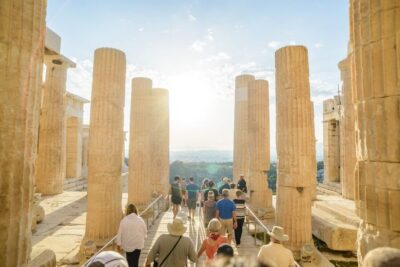
Acropolis: Premium Acropolis and Parthenon Guided Tour
Read our review →
Luxury Catamaran Cruise from Athens with Traditional Greek Meal and BBQ
Read our review →
Hydra, Poros and Egina Day Cruise from Athens with Optional VIP Upgrade
Read our review →
Premium Delphi Day Trip with an Expert Guide, Museum & Lunch
Read our review →
Athens Pub Crawl with 1hr Open Bar & VIP Nightclub Access
Read our review →Athens Pub Crawl with 1hr Open Bar & VIP Nightclub Access
Read our review →
PREMIUM Semi-Private Athens Afternoon Food Tour & Wine Tasting
Read our review →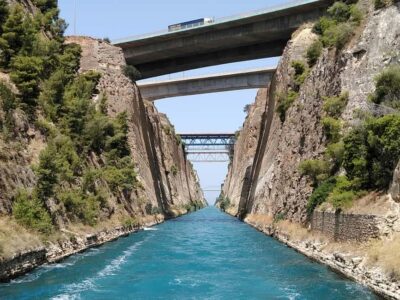
Athens: Corinth Canal, Mycenae & Nafplio Premium Guided Tour
Read our review →Browse the lists this tour appears in