
Review · WASHINGTON DC
The Smithsonian National Air & Space Museum Exclusive Guided Tour
The most useful part of this Smithsonian Air and Space Museum tour is its clear route through a huge collection. In about two and a half hours, your guide links the Wright brothers, the Space Race, moon landings, and modern astronaut life instead of leaving you to wander among labels.
I like the choice between a private tour and a lower-cost semi-private option. I also like the way guides such as Rebecca, Tim, Ryan, Meghan, Paul, and Christopher have kept families engaged with questions, humor, and stories. The main concern is the multi-year renovation: some famous exhibits listed for the tour may not be open on your date.
Key points to know
- Apollo 11 and the Wright Flyer: The planned highlights connect the first powered flight with the first moon landing.
- A guide keeps the museum manageable: You spend less time finding your way and more time understanding what you see.
- Renovation changes the route: Check the museum’s current exhibition page before booking because displays can change.
- Private or semi-private choices: A private group gets the guide exclusively, while the save option does not.
- Families get useful help: Guides have adapted explanations for children and handled questions with patience.
- The price pays for guidance, not admission alone: Museum entry may be free, so the value rests mainly in access planning, focus, and interpretation.
Why a guided visit helps at this particular museum
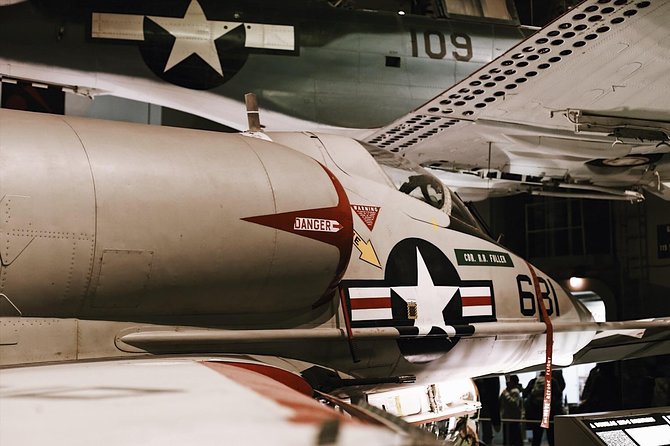
The National Air and Space Museum can be hard to tackle on your own. Its subject reaches from early aircraft to orbital missions, military aviation, commercial flight, and NASA technology. Even with galleries closed, the open portion can give you more material than you can absorb in one quick visit.
A guide gives the visit a shape. Instead of stopping at every object with no sense of priority, you follow a route built around major turning points. You might begin with the Wright Flyer, move through the growth of aviation, and then shift toward Mercury, Apollo, and later spaceflight.
I like this approach for a first visit. You still have time to look at the artifacts, but you are less likely to miss why they matter. A good guide also adds the human side: Amelia Earhart’s career, the pressure of the Space Race, the risks of test flying, and the daily reality of being an astronaut.
The tour is offered in English, with morning and afternoon start times. The group choice matters. A private tour gives your party its own guide, while the save, semi-private option does not include a guide exclusively for your group and is not listed as wheelchair friendly.
More Museum Visits in the USA:
- “The Met” Metropolitan Museum of Art Exclusive Guided Tour
★ 5.0 · 863 reviews - Chicago: Field Museum of Natural History Ticket or VIP Tour
★ 4.7 · 717 reviews - Smithsonian Museum of Natural History – Exclusive Guided Tour
★ 5.0 · 446 reviews
What you may see inside the museum
The advertised route includes some of the museum’s best-known aviation and space objects, though the current building work makes the exact selection uncertain.
The original Wright Flyer is the natural starting point for the story of powered flight. This is not just an old aircraft to glance at. It represents the Wright brothers’ successful answer to a problem that had defeated many earlier experimenters: how to control a heavier-than-air machine in flight.
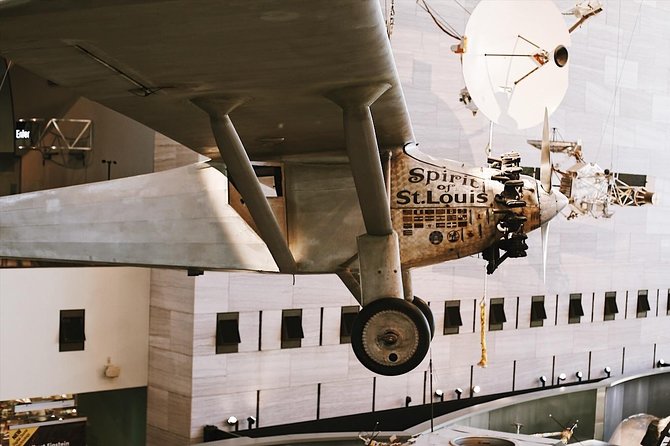
The museum also features Charles Lindbergh’s Spirit of St. Louis, the aircraft associated with the first solo nonstop flight across the Atlantic. A guide can place that achievement beside the earlier Wright flight and show how quickly aircraft design and ambition changed.
Chuck Yeager’s Bell X-1 adds another chapter. It represents the era of high-speed test flight and the push beyond the sound barrier. These aircraft help make the museum useful even if you are more interested in airplanes than in rockets.
The space section is the emotional core for many people. Planned highlights include Neil Armstrong’s Apollo 11 spacesuit, Buzz Aldrin’s spacesuit, moon boots, moon rocks, lunar modules, and John Glenn’s Mercury capsule. Seeing the actual objects, when they are on display, gives the moon program a physical scale that photographs cannot provide.
The collection also includes a backup lunar module, a test vehicle for the Hubble Space Telescope, a backup of Skylab, and a model of the Space Shuttle mid-deck. These are important distinctions. Not every object is the flight-used original, and a guide can explain why a test vehicle or backup remains valuable.
The museum’s Hubble and Skylab displays help you picture the machinery involved in space exploration. The original Hubble remains in orbit, so the test vehicle is the practical way to see its structure up close. Skylab, America’s first space station, offers a look at how astronauts lived and worked before the International Space Station era.
Renovation changes what you will actually see
This is the most important booking warning. The museum is under major construction for several years, and the available galleries can change as work progresses. The tour description names famous objects, but you should not treat that list as a promise that every item will be visible on your date.
Before booking, check the museum’s current exhibition page at airandspace.si.edu/exhibitions/now-view. That page gives you a better picture of what is open now. It is also wise to check again shortly before your visit, since construction stages and gallery access can shift.
The renovation does not make the tour pointless. In fact, a guide may be especially useful when the normal route is interrupted. The route can be adjusted to the exhibits that remain open, and a guide can explain what you are seeing instead of leaving you to wonder why a familiar object is missing.
Still, you should set your expectations correctly. If your main goal is one particular spacecraft or suit, confirm its current display status first. The museum’s free admission does not guarantee that every popular gallery will be operating.
How the two-and-a-half-hour route works
You meet your guide at 600 Independence Ave SW, at the museum in Washington DC. The activity ends back at the meeting point, so you can continue sightseeing on the National Mall afterward.
The route begins with the broad story of flight. You can expect stops tied to the Wright brothers, Amelia Earhart, Lindbergh, and the development of commercial aviation. This gives children and adults a common starting point, even if one person arrives for airplanes and another only cares about Apollo.
The tour then moves toward space exploration. Expect discussion of NASA, the Mercury program, the Apollo missions, the Space Race, and the technology needed to land people on the moon. The guide’s role is not only to point at hardware, but to connect machines with decisions, risks, and people.
The final section may include modern astronaut life and the way space exploration continues today. The exact order depends on which galleries are open and how the museum is operating that day.
Two hours is not enough for every object. That is part of the bargain. You get a focused introduction, not a complete scholarly visit. If you have a special interest in aircraft design, women in aviation, spacecraft engineering, or NASA history, tell the guide early. Several guides have adjusted the route around group interests and questions.
A few more luxury tours around the USA worth a look
- Guided Tampa Sightseeing Tour in a Deluxe Street Legal Golf Cart
★ 5.0 · 1,344 reviews - Page: Upper Antelope Canyon Prime Time Entry & Navajo Guide.
★ 4.6 · 619 reviews - Skip-the-line National Archives Building Exclusive Guided Tour
★ 5.0 · 381 reviews - Guided Hobie Kayak EcoTour: Premium Eco Experience Bonita Springs
★ 5.0 · 365 reviews
Guides make the biggest difference
The strongest part of this experience is the human guide. Rebecca has been praised for connecting aviation milestones with the people behind them and for adjusting her explanations to the group. She has also been especially patient with children, including a chatty eight-year-old.
Tim has been described as friendly, funny, and effective with families. He has kept children interested while covering a large amount of information. Ryan has handled private tours well, offering extra facts and keeping the route moving. One family also noted that he stayed calm and helpful when the building lost power during their visit.
Meghan has worked well with groups of mixed ages, offering a lively overview of the Wright brothers, commercial flight, and NASA. Paul has brought personal knowledge to the space material, while Christopher and Leigh have also received praise for clear and entertaining presentations.
You cannot assume that you will receive a particular guide, and the booking details do not promise a guide by name. Still, these repeated strengths tell you what to expect from the better version of the tour: a flexible speaker who invites questions, keeps the group together, and explains complex subjects in plain language.
That matters more here than at a small museum. The objects are impressive on their own, but the stories help you see why they changed aviation and space exploration.
Is $89.67 a fair price?
The listed price is $89.67 per person. Museum admission itself may be free, so you should not think of this as an $89.67 ticket to the building. You are paying mainly for the guided structure, help with entry, and the chance to cover major highlights efficiently.
That can be good value if you have limited time in Washington DC. A guide can prevent you from spending half your visit searching for the exhibits you came to see. The tour also offers a better chance of getting into the museum when timed entry availability is tight, though the renovation still affects what you can view.
The price is harder to justify if you enjoy reading every label at your own pace or plan to return several times. A self-guided visit gives you more freedom and avoids the tour fee, although you will need to manage your own route and current entry arrangements.
Group discounts may be available, and private and semi-private options let you choose how much personal attention you want. For a family that wants a clear introduction, the fee can make sense. For a solo visitor or a pair on a tight budget, compare the tour cost with the value of your time.
Gratuities are not included. Hotel pickup and drop-off are also not included, so plan to reach the museum independently. Uber, a taxi, and public transportation are suggested options, and the museum is near public transportation.
Families, accessibility, and practical limits
Families are a strong match for this tour. Guides have used questions and humor to keep children involved, and the subject naturally offers memorable objects: moon boots, spacesuits, capsules, rockets, and historic aircraft.
The museum is wheelchair friendly with the private tour option. The supplied details specifically exclude that guarantee for the save, semi-private option, so ask before booking if accessibility is important to your group.
You need a moderate level of physical fitness. The tour involves moving through museum galleries for about two and a half hours, and some areas may have lines because of security or changing access. Wear suitable clothing for entry into the sites included in the tour.
Security rules also matter. Large bags and suitcases are not allowed inside. Bring only a handbag or small, thin backpack. Some rooms require quiet or limit speaking, so your guide may explain the material before you enter rather than talking through the space.
The meeting instructions ask you to provide a mobile phone number with country code. Keep your phone available on the day in case the operator needs to reach you.
A small museum-shop extra
At the end, you can continue exploring Washington DC, or stop in the gift shop for freeze-dried astronaut ice cream. It is not included in the tour price, but it is a lighthearted way to extend the space theme, especially for children.
Do not mistake this for a major part of the experience. The value is in the museum and the guide, not the snack. Still, it makes a simple souvenir and gives younger visitors one more concrete link to astronaut life.
Who should book this experience?
I would choose this tour if you have only one visit to the museum, want the major stories explained, or are visiting with children of different ages. It is also useful if ordinary timed entry is unavailable and you want a structured way into one of Washington’s most popular museums.
I would be more cautious if you have a single must-see object. Check the current museum page first, because construction may keep it off view. I would also skip the tour if you prefer to spend several hours studying one aircraft or spacecraft in detail.
Book the private option if you want the guide to shape the visit around your family or interests. Choose the semi-private option if price matters more and you are comfortable sharing attention. Either way, allow for security and construction-related changes, and do not expect every advertised object to be available.
The free cancellation policy is useful if plans are uncertain: cancel at least 24 hours before the start time for a full refund. Changes or cancellations inside that window are not accepted for a refund, and the operator may offer a new date or a full refund if the minimum number of participants is not met.
FAQ
Where does the Smithsonian Air and Space Museum tour begin?
The meeting point is 600 Independence Ave SW, Washington, DC 20560, at the National Air and Space Museum.
Where does the activity end?
The tour ends back at the meeting point inside or at the museum location.
How long does the guided tour last?
The experience lasts approximately two and a half hours. The museum itinerary itself is listed as about two hours, with the full activity described as 2.5 hours.
What language is the tour offered in?
The tour is offered in English.
Can I choose a private tour?
Yes. You can choose a private tour for your group or select the save, semi-private option. The guide is exclusively for your group only with the private option.
Is museum admission included?
The experience includes a guided museum tour and entry arrangements, but the listed itinerary identifies the museum admission ticket as free. The tour price mainly covers the guided experience and related service.
Are all the advertised exhibits guaranteed to be open?
No. The museum is under major construction for several years, and exhibits may change or be unavailable. Check the museum’s current exhibition page before your visit.
Is the tour wheelchair friendly?
The private tour is listed as wheelchair friendly. This does not apply to the save, semi-private option according to the tour details.
Can I cancel for a full refund?
Yes, if you cancel at least 24 hours before the local start time. Cancellations or changes made less than 24 hours before the start time are not accepted for a refund.
Just added around the USA
- Cleary Summit Aurora Glass House Luxury Northern Lights Tour★ 4.5 · 16 reviews
- Vip Aurora Adventure from Fairbanks★ 4.5 · 18 reviews
- Private Chartered Luxury Pontoon Boat in Destin-Up to 6 Guests★ 5.0 · 52 reviews
- Private Luxury Sunset Cruise in Panama City Beach★ 4.5 · 27 reviews
- Luxury Catamaran Sunset and Wine Cruise from Dana Point★ 4.5 · 44 reviews
- Premium Non-Private 3 Hour Crab Island Tour with Bathroom★ 5.0 · 31 reviews
- Private Crab Island Luxury Slide Pontoon Charter★ 5.0 · 20 reviews
- Swim with Manatees: Eco-Educational Tour in Crystal River★ 5.0 · 247 reviews
Washington DC VIP Tours, compared.

Smithsonian Museum of Natural History – Exclusive Guided Tour
Read our review →
Skip-the-line National Archives Building Exclusive Guided Tour
Read our review →
Smithsonian Museum of American History Exclusive Guided Tour
Read our review →Browse the lists this tour appears in