
Review · ITALY
Pompeii: Exclusive Tour with Archaeologist and Entry Tickets
Pompeii is easiest to understand when someone shows you where ordinary life happened. This two-hour walk takes you from the old Porta Marina gate through the Forum, temples, shops, houses, baths, and theater district with an archaeologist who has worked at the site. I especially like the small-group format and the headsets, which help you hear the guide over the noise and open-air spaces.
The tour also makes good use of your time by including the entry ticket and taking you straight through the ticket queue. The tradeoff is simple: two hours gives you a strong introduction, not a complete visit. Pompeii is huge, so you may want to remain inside afterward and explore at your own pace.
Key points at a glance
- Meet beside the train station: The guide waits outside Porta Marina, directly in front of Pompei Scavi, Villa dei Misteri station, holding a Pompei VIP sign.
- See the city in a logical sweep: The route connects the gate, civic center, temples, market, homes, taverns, brothel, and theater district.
- Learn from an archaeologist: Guides such as Antonio, Riccardo, Livio, Raffaelle, and Loredana are praised for clear explanations, humor, and a strong grasp of daily Roman life.
- Expect an efficient pace: The route covers a lot in two hours, with time for photos and questions, but not every corner of the ruins.
- Choose your group style: You can book a shared small group or select a private option.
- Plan for rough ground: Comfortable shoes and water matter, and the tour is not suitable for wheelchair users or people with mobility impairments.
Why a guide changes Pompeii
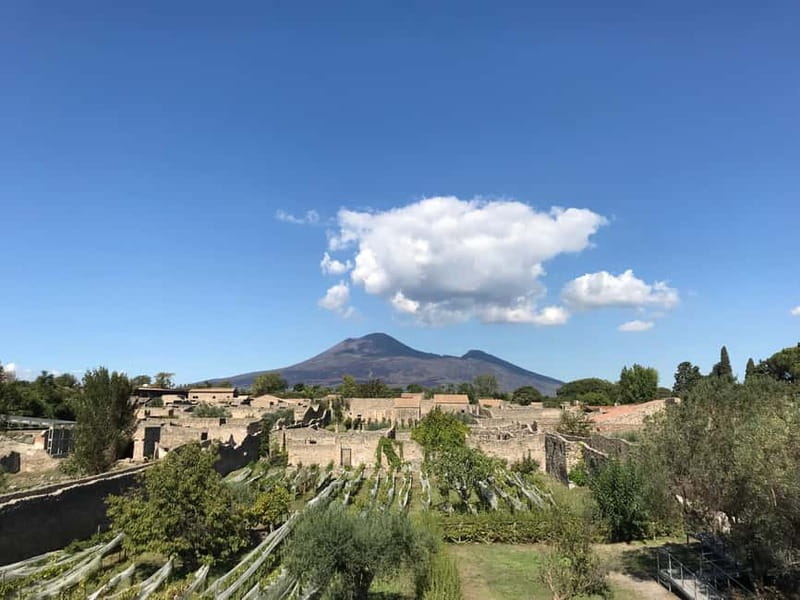
Pompeii can look like a field of broken walls if you arrive without context. A guide helps you read the remains as a functioning Roman town: the Forum as the civic center, the Macellum as a market, the thermopolia as places to buy prepared food, and the large houses as statements of wealth and status.
That context is the main reason I would choose this experience instead of simply buying an entry ticket. A good guide does not just name a building. The guide explains how spaces worked, what people did there, and what archaeologists can learn from ovens, painted walls, mosaics, streets, and household objects.
The archaeologist background adds another useful layer. You can ask about excavation methods, new discoveries, and how researchers work out what happened in a city buried by the eruption of Mount Vesuvius in 79 AD. The best guides on this tour, including Antonio and Riccardo, are described as warm, clear, and able to explain serious material without turning the walk into a lecture.
Pompeii is also an emotional place. The plaster casts show the final moments of people caught in the eruption, and the contrast between fine homes and sudden destruction can be unsettling. A thoughtful guide gives these remains proper weight without making the visit feel sensational.
More Tickets and Entries in Italy:
- Florence: Statue of David & Duomo Guided Tour with Tickets
★ 4.5 · 357 reviews - Florence: Vip early Timed Entry Ticket Uffizi Gallery
★ 5.0 · 34 reviews - Paris: Fondation Louis Vuitton Premium Access Ticket
★ 4.7 · 4,055 reviews
Meeting at Porta Marina
The meeting point is outside Pompeii’s Porta Marina entrance, directly in front of the Pompei Scavi, Villa dei Misteri station on the Circumvesuviana railway. Look for a guide holding a sign marked Pompei VIP.
This location is useful if you arrive by train, but pay attention to the station name. Pompeii has several stations, and arriving at the wrong one can make a tight meeting time stressful. The tour does not include transportation, so you need to arrange your own way to the ruins.
Porta Marina was one of the original Roman entrances. Starting here gives the tour a clear sense of arrival, rather than dropping you into the archaeological area without orientation. From the gate, you move into the city and begin to see how the streets, public buildings, and private homes fit together.
Bring photo identification for every participant, including children. The current ticketing rules require the full name, surname, and age of each person, and your ID or passport may be checked. A photo of the document is accepted according to the activity information.
The Forum, Basilica, and temples
The first major section takes you toward the Basilica and the Foro Civile, or Roman Forum. This was the center of public life, where politics, religion, trade, and civic business met. The open space can be hard to interpret on your own, but the surrounding buildings help explain Pompeii’s social order.
The Basilica is especially useful for understanding the town’s legal and commercial life. Your guide can point out how the building related to the Forum and why this civic center mattered to residents.
The Temple of Jupiter gives the route a strong religious focus. You also visit the Temples of Apollo and Venus, which show that Pompeii’s sacred life was spread across several important cult sites. The remains are incomplete, so the guide’s explanation matters more than the stones alone.
I like this part of the tour because it sets up the rest of the visit. Once you understand the public center, private houses and shops become easier to place. You begin to see Pompeii as a working town rather than a collection of isolated monuments.
Forum Baths and the Macellum
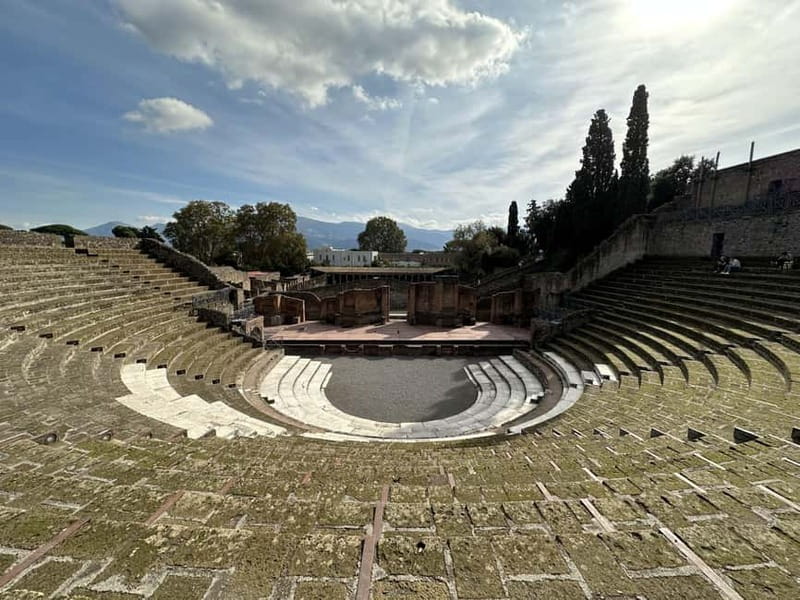
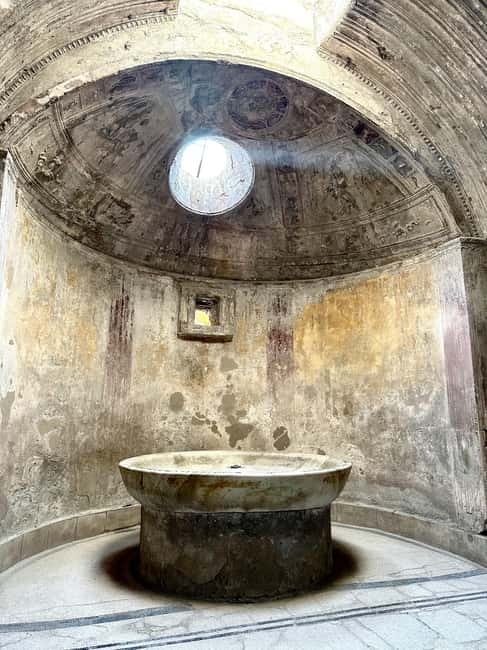
The Forum Baths offer a look at Roman bathing culture and the practical engineering behind it. Baths were not only for washing. They were social spaces, and their layout shows how carefully Romans designed public buildings for heat, water, and movement.
Next comes the Macellum, the city market. This is one of the stops where the human cost of the eruption becomes most direct, since the plaster casts of victims are displayed here. The casts can be difficult to see, particularly for children, so parents may want to prepare younger visitors for what they will encounter.
The guide’s role is important at this point. A good explanation keeps the focus on the people and on the archaeological process, rather than treating the casts as a shocking photo opportunity. The tour description promises access to the human story of Pompeii, and this is the clearest example of that promise.
A few more luxury tours around Italy worth a look
- From Milan: Como, Lugano and Bellagio Exclusive Boat Cruise
★ 4.8 · 6,635 reviews - Legendary Venice: Doge’s Palace, St Mark’s & VIP Terrace Access
★ 4.5 · 5,033 reviews - From Naples: Exclusive Tour of Amalfi Coast
★ 4.8 · 3,970 reviews - Rome: Colosseum Arena, Roman Forum & Palatine Hill VIP Tour
★ 4.5 · 3,674 reviews
Pompeian homes and their painted rooms
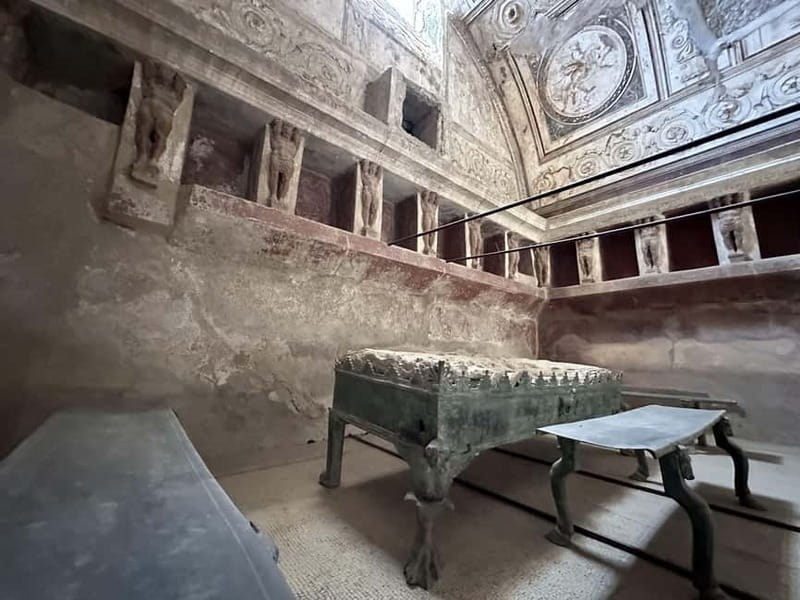
The House of the Tragic Poet, House of the Vettii, and House of the Faun show how much Pompeian life took place inside private residences. These were not plain homes. Their courtyards, reception rooms, wall paintings, mosaics, and decorative details reflected the owner’s wealth and ambitions.
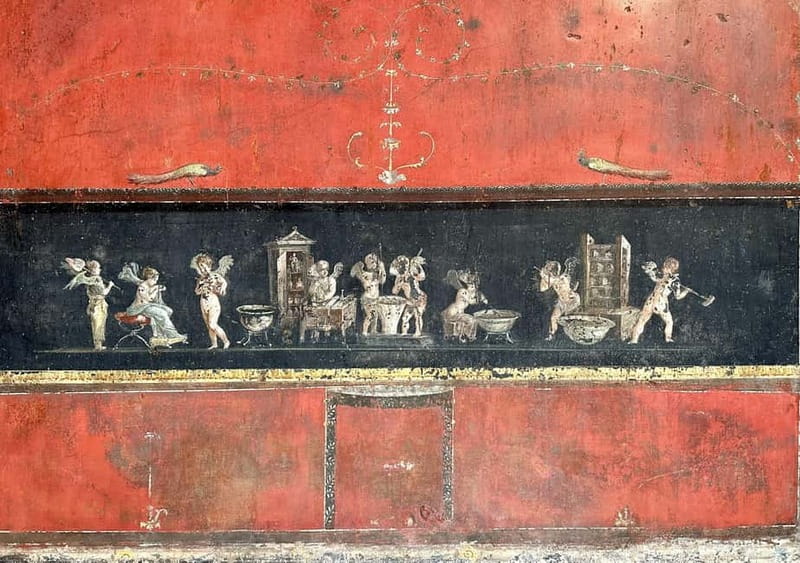
The House of the Vettii is known for its elaborate decoration, and the House of the Faun is one of Pompeii’s grandest residences. The tour also points out frescoes and mosaics, where surviving colors and patterns give you a better sense of the city’s original appearance.
The House of the Tragic Poet adds another angle. Its name comes from the literary and artistic details associated with the property, making it a useful stop for discussing education, taste, and domestic display.
Access to individual buildings can change at archaeological sites, so do not treat every interior as guaranteed on every date. The route includes these major houses, but temporary closures or site rules can affect what you see. Even when one room is unavailable, the guide can usually explain its place in the wider plan.
Taverns, bakeries, and the Lupanare
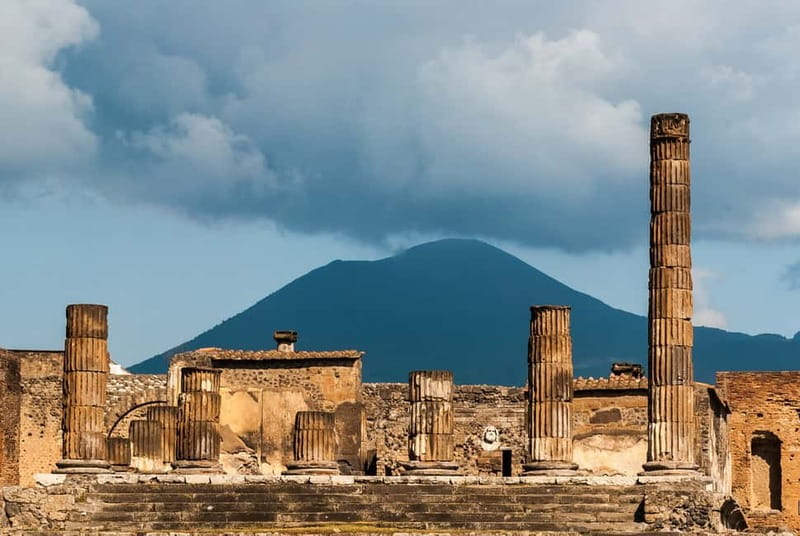
Pompeii becomes most vivid when the tour turns from grand public buildings to ordinary commerce. The thermopolia were ancient snack bars or taverns, while bakeries reveal the practical side of feeding a town. These places help you picture the daily routines that often disappear behind monumental ruins.
This is also where the visit becomes especially useful for families and younger visitors. The idea of buying food from an ancient counter is easier to picture than a discussion of civic architecture, and the guide can connect these small businesses to the wider street life.
The Lupanare, Pompeii’s famous brothel, is another memorable stop. Its painted panels and small rooms raise questions about sex work, privacy, and Roman social life. Some content may not suit every child, so parents should decide how closely younger family members should follow this section.
The best part of seeing these sites with a guide is that you get more than a quick label. You can ask how the spaces were used and how archaeologists interpret evidence that is not always obvious to modern eyes.
The theater district and the end of the walk
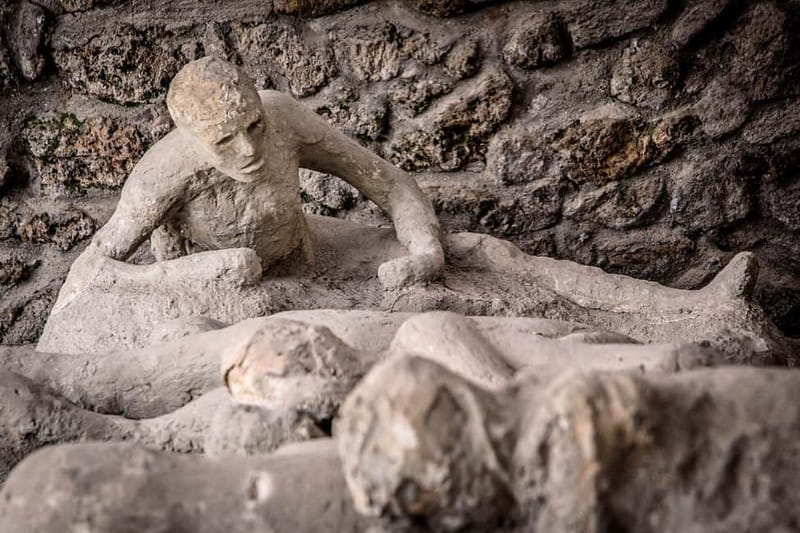
The Large Theatre brings the tour back to public entertainment. Its scale shows that Pompeii’s residents gathered for performances as well as commerce, religion, and political business. The theater district gives the final portion of the route a different mood from the Forum and houses.
The guide aims to finish at Pompeii Ruins or Piazza Esedra. From there, you can leave the site or continue exploring independently if opening hours and access rules allow. That extra time is valuable because the tour gives you the framework, then lets you choose what deserves a closer look.
I would use the guided portion to learn the layout and priorities of the city. Afterward, you might revisit a house, look for more frescoes, spend time with the street paving, or seek out areas the group did not have time to cover. One visitor stayed for the rest of the day after the tour, which is a sensible plan if you enjoy archaeology and can manage the walking.
The two-hour pace and group size
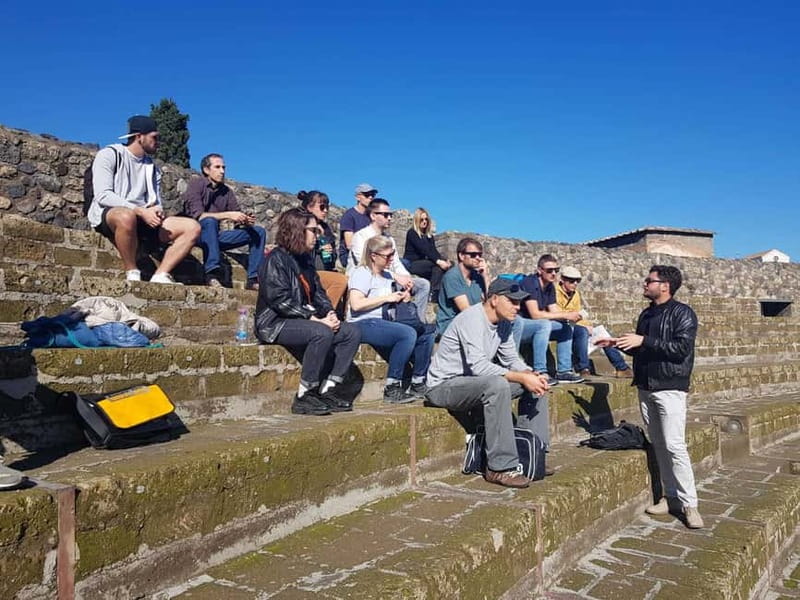
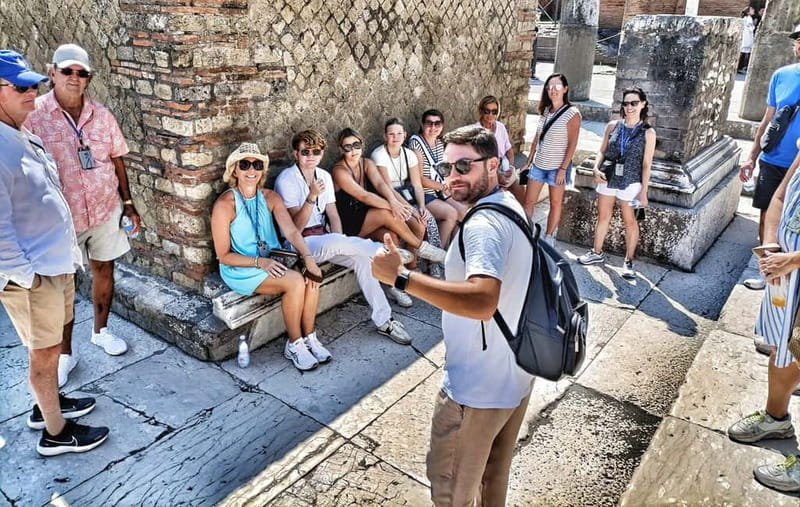
Two hours is a practical length for a first visit, especially if Pompeii is one stop in a busy Campania trip. The guide keeps moving, but the route allows for photos and questions. Several guides, including Livio, Antonio, and Monica, are praised for choosing a steady pace and organizing the group well.
The format is best for people who want a clear introduction rather than a slow study of every building. You will cover a lot: the Forum, Basilica, three temples, baths, market, three major houses, the Lupanare, and the theater district.
A shared small group keeps the price at $50 per person and offers the social ease of touring with others. A private booking costs more than a shared place if the price changes by date or group size, but it gives you more control over questions, pace, and family needs. The private option was particularly useful for one couple who had previously taken a larger group tour and found the experience much more personal.
The headset is not a minor extra. Pompeii is open, spread out, and often busy. Being able to hear the guide while standing several steps away helps you keep your eyes on the buildings instead of staying shoulder to shoulder with the group.
Is $50 a fair price?
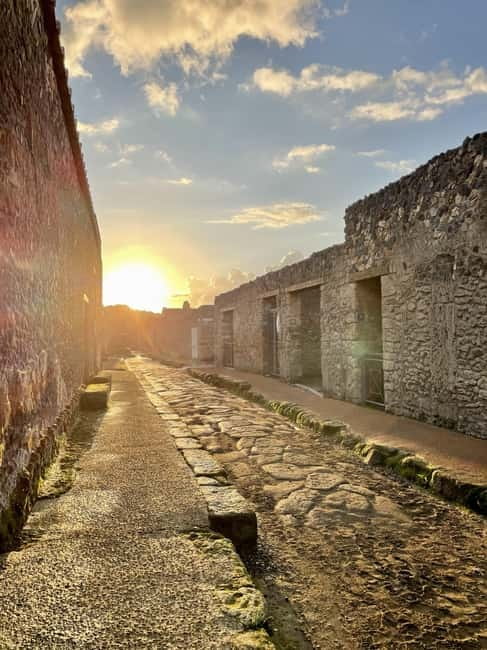
At $50, this tour offers reasonable value if you would otherwise enter Pompeii without much background. The ticket is included, the ticket queue is bypassed, and you receive two hours with an archaeologist and licensed guide. The savings are not only financial. You also avoid spending your first hour trying to understand a confusing map.
The value depends on how you use the visit. If you only have two or three hours in Pompeii, a guided route makes the time count. If you plan to spend a full day at the ruins, the tour works well as an introduction, but you should not mistake it for the whole experience.
Food, drinks, and transportation are not included. Bring water, since the site involves substantial outdoor walking. Wear comfortable shoes, as the ancient streets can be uneven and tiring.
The tour is not suitable for wheelchair users or people with mobility impairments. Electric wheelchairs are not allowed, and pets are not allowed either. Swimwear, alcohol, and drugs are also prohibited.
What the guides do best
The strongest part of this experience is the quality of the guiding. Antonio is repeatedly described as passionate, organized, and able to explain Pompeii’s excavation process. Riccardo is praised for clear English, humor, and his grasp of archaeology, Latin, and Greek. Livio is noted for his warmth and enthusiasm, while Raffaelle and Loredana are praised for making the site accessible to adults and children.
Those details matter because Pompeii needs interpretation. The ruins do not explain themselves, and a guide who can answer questions about daily life, trade, language, religion, and excavation methods adds real value.
You should also expect variation in personality. The activity is conducted in English, Italian, French, or Spanish, and your guide may have a different style from the names above. The consistent pattern is a professional approach, clear delivery, and willingness to answer questions.
Who should book this Pompeii tour?
I would choose this tour if you are visiting Pompeii for the first time, arriving by train, traveling with children or teenagers, or working with limited time. It is also a good fit if you like history but do not want to spend hours preparing before you arrive.
It suits couples and families who want a focused route, as well as solo visitors who appreciate help finding the meeting point and staying oriented. The private choice makes more sense for a group with a shared interest, a flexible budget, or specific questions about archaeology.
I would think twice if you want total freedom from the first minute. A group tour follows its own route and pace, and two hours cannot cover every street. Visitors with limited mobility should also look for a different way to experience the site.
Should you book it?
Book this experience if you want Pompeii to make sense, not just look impressive. The combination of entry tickets, a small group, headsets, and an archaeologist gives you a strong start, especially at a site this large.
The most practical plan is to take the tour early in your visit, then remain inside to explore on your own if you have the time and energy. At $50, it is a sound choice for a first look at the Forum, homes, markets, theaters, and the human story behind the ruins. Just arrive at the right station, bring identification and water, wear good shoes, and accept that this is an introduction rather than the final word on Pompeii.
FAQ
Where does the Pompeii tour meet?
The meeting point is outside the Porta Marina entrance, directly in front of the Pompei Scavi, Villa dei Misteri Circumvesuviana train station. The guide holds a sign marked Pompei VIP.
How long does the tour last?
The guided visit lasts two hours. Starting times vary, so check availability when booking.
Is the Pompeii entry ticket included?
Yes. Skip-the-line entry tickets and Pompeii admission Express tickets are included.
Is this a private tour?
You can choose between a shared small-group experience and a private booking.
Which languages are available?
The live guide service is available in English, Italian, French, and Spanish.
Do I need to bring identification?
Yes. Bring a passport or ID card for each participant, including children. The ticketing rules require each person’s full name, surname, and age, and a photo of the document is accepted.
What should I bring?
Wear comfortable shoes and bring water. Identification is also required.
Is the tour suitable for wheelchair users?
No. The activity is not suitable for wheelchair users or people with mobility impairments. Electric wheelchairs are not allowed.
Just added around Italy
- Exclusive Siena and San Gimignano Tour & Chianti Wine Experience★ 5.0 · 19 reviews
- Cinque Terre & Pisa Premium Tour from Florence★ 5.0 · 170 reviews
- From Florence:Tuscany Tuk Tuk with Lunch, Wine & San Gimignano★ 5.0 · 15 reviews
- Exclusive Winery Tour with Tasting and Dinner in Chianti vineyard★ 4.5 · 49 reviews
- Exclusive Cinque Terre by Ferry with stop in Pisa from Florence★ 5.0 · 16 reviews
- Florence: Vip early Timed Entry Ticket Uffizi Gallery★ 5.0 · 34 reviews
- Premium Private Tour to Siena, Pisa, San Gimignano and Tuscany★ 5.0 · 143 reviews
- Exclusive Private Tuscany Wine Tour & Food Pairing Session★ 5.0 · 70 reviews
Italy VIP Tours, compared.
From Milan: Como, Lugano and Bellagio Exclusive Boat Cruise
Read our review →
Legendary Venice: Doge’s Palace, St Mark’s & VIP Terrace Access
Read our review →

From Naples: Premium Tour of Sorrento, Positano, Amalfi
Read our review →
Sorrento: Exclusive Capri Boat Tour and Optional Blue Grotto
Read our review →
VIP Vatican Breakfast and Guided Tour with Sistine Chapel Access
Read our review →
Colosseum, Roman Forum & Palatine Hill Guided Tour
Read our review →
Florence: Premium Pizza & Gelato Preparation Class with Wine
Read our review →Browse the lists this tour appears in